


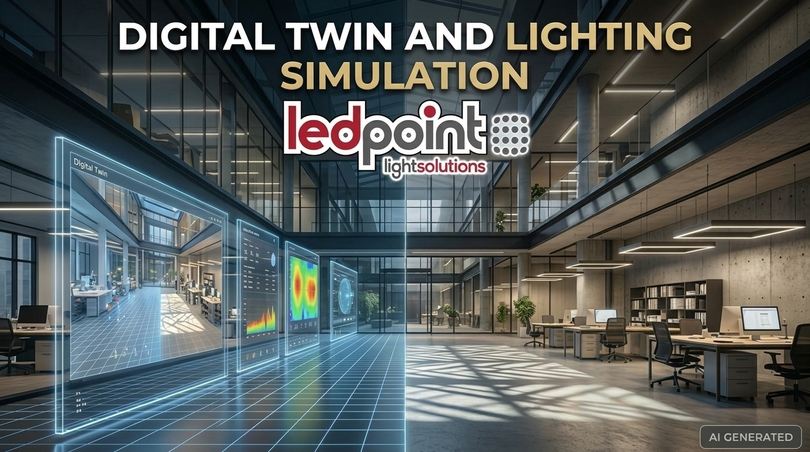
The lighting digital twin is the digital, live and synchronized replica of a real light system: a 3D model that receives data from the field, displays it and sends commands back to the fixtures. It combines lighting simulation, DALI-2, DMX/RDM or Wi-Fi control and telemetry to design, verify and manage light before and after installation.
Imagine being able to enter a 600 m² shop before the first LED strip is laid, walk between the shelves, lower the window light to 40%, warm the color temperature of the fitting-room area to 2700 K and see, in real time, how many lux reach the checkout counter and how many watts you are consuming. Then imagine that, once the system is finished, that same model continues to live: every controller, every power supply and every dimming channel sends its status to the virtual twin, which in turn can send new scenes to the field. This is the digital twin applied to light, and it is the technology that is transforming lighting simulation from a static exercise into an operational tool for the entire building lifecycle.
For years light simulation was a photograph: average illuminance was calculated, a rendering was generated and the file ended up in the archive. The digital twin changes the rules because it connects that photograph to the real world, turning it into a continuous film. In this technical guide, written by the Ledpoint team for electricians, designers, architects, condominium administrators, electrical material retailers and home automation enthusiasts, we explain what a lighting digital twin is, how it is built, which protocols are needed and which products in the Ledpoint.it catalog make it possible to create its physical and control layers.
You will find comparison tables, a complete example lighting calculation, the five operational phases for commissioning a digital twin, the criteria for choosing between DALI-2, DMX/RDM, Casambi, Zigbee, Tuya/Matter and KNX, and a section dedicated to each professional profile. The goal is simple: by the end of this reading you will know whether a digital twin makes sense for your project, how much it costs in terms of components and how to start with reliable, safe and quick-to-install hardware.
In this article...
1. What a digital twin is in lighting
Before talking about protocols, controllers and power supplies, it is essential to clarify the concept. The term digital twin is often used imprecisely, as a synonym for "3D model" or "realistic rendering". In reality, a digital twin is something more precise and more powerful, and understanding the difference is the first step to designing well.
Technical definition of digital twin
A digital twin is a virtual representation of a physical object, system or process, kept constantly aligned with its real counterpart through a bidirectional data flow. The concept originated in aerospace and manufacturing, where digital twins are used to monitor engines, production lines and industrial plants. Today the same logic is applied to buildings and, increasingly specifically, to lighting systems.
In the case of light, the digital twin consists of three inseparable elements: the geometric and photometric model of the space (walls, materials, reflectances, position of each fixture), the electrical and control model (which LED strip is connected to which channel, of which controller, powered by which driver) and the real-time data flow that synchronizes the status of physical devices with that of virtual devices.
The three differences between 3D model, simulation and digital twin
To avoid confusion, it is useful to establish three levels of increasing maturity. Each has its value, but only the last deserves the name digital twin.
Level 1: the digital model
It is a 3D model of the space, perhaps with luminaires positioned. It does not receive data from the field and does not send commands. It is used for presentations and design coordination. A digital model is not a digital twin.
Level 2: the digital shadow
The model receives data from the field, for example on/off status or dimming level, but cannot send commands. It is useful for monitoring and maintenance, but the flow is one-way.
Level 3: the actual digital twin
The flow is bidirectional: the model reads the real status and can modify the system. If in the virtual twin you set the window to 70% and 3500 K, the physical controller receives the command and executes it; if a driver fails in the field, the digital twin immediately reports it on the 3D map.
Why the digital twin is especially relevant to lighting
Lighting is one of the building subsystems best suited to digital twin logic for at least four reasons. First, light can be measured with precise quantities: lux, lumens, color temperature, color rendering index, watts. Second, modern LED systems are already digital by nature: each channel of a controller is an addressable data point. Third, light directly affects consumption, sales, comfort and well-being, so every optimization has a measurable return. Fourth, new-generation LED strips and controllers communicate with open protocols that make integration with digital twin software relatively simple.
In short, the lighting digital twin is the meeting point between classic lighting simulation, which deals with "what the light will be like", and building automation, which deals with "how to manage the light". The digital twin does both, on the same model, throughout the life of the system.
2. Digital twin market and figures in 2026
Talking about digital twins is no longer a futuristic exercise. Market figures show one of the fastest growth rates in the entire digital sector, and construction and building management are among the segments driving demand most strongly. Let's look at the most recent data and what it means for those who work with light.
Global and European market estimates
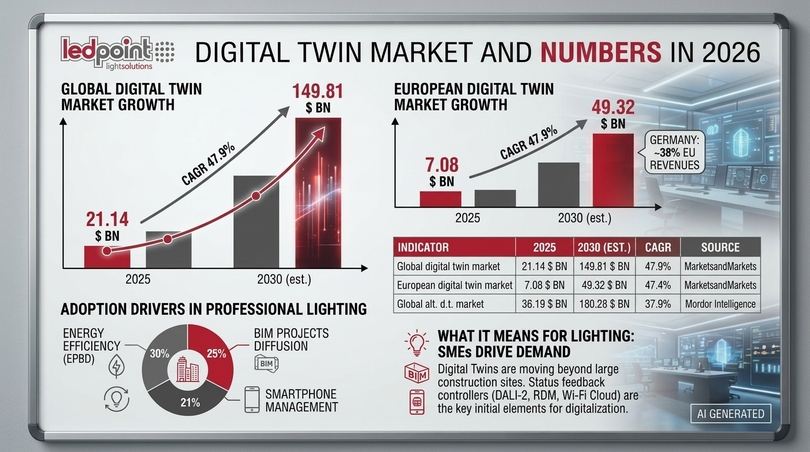
According to MarketsandMarkets, the global digital twin market will grow from approximately USD 21.14 billion in 2025 to USD 149.81 billion in 2030, with a compound annual growth rate (CAGR) of 47.9%. For Europe, the same source estimates growth from USD 7.08 billion to USD 49.32 billion over the same period, with Germany accounting for almost 38% of the continent's revenue and with small and medium-sized enterprises indicated as the fastest-growing segment. Other institutions, such as Mordor Intelligence, offer different estimates but always with growth rates above 35% per year.
| Indicator | 2025 | 2030 (estimate) | CAGR | Source |
|---|---|---|---|---|
| Global digital twin market | USD 21.14 bn | USD 149.81 bn | 47.9% | MarketsandMarkets |
| Europe digital twin market | USD 7.08 bn | USD 49.32 bn | 47.4% | MarketsandMarkets |
| Global digital twin market (alternative estimate) | USD 36.19 bn | USD 180.28 bn | 37.9% | Mordor Intelligence |
What these figures mean for lighting
The aggregate figures include manufacturing, energy, healthcare and infrastructure, not only light. But the interesting point for our sector is another: the strongest growth concerns SMEs, i.e. precisely the organizations that manage shops, restaurants, hotels, professional studios and small tertiary buildings. This means that the digital twin is moving out of large construction sites and into medium-sized projects, where controlled LED lighting is often the first system to be digitized.
In our experience at Ledpoint, observing the technical requests coming from the professional channel, demand for controllers with status feedback (DALI-2, DMX with RDM, Wi-Fi with cloud app) has grown steadily in recent years, driven by three factors: energy efficiency requirements, the spread of BIM projects and end customers' request to manage everything from a smartphone. These are exactly the three ingredients of the digital twin.
Regulatory and economic drivers
The adoption of digital twins in lighting is also driven by regulatory factors. The European Energy Performance of Buildings Directive (EPBD) promotes building automation and control systems (BACS) in non-residential buildings, while the spread of BIM in public tenders makes structured 3D models available that are the natural basis of the digital twin. Those who design a light system compatible with the digital twin today are already responding to tomorrow's requirements.
3. Traditional lighting simulation vs digital twin
Traditional lighting simulation is and will remain a fundamental tool. The digital twin does not replace it: it extends it over time and connects it to the field. Understanding where one ends and the other begins helps choose the right level of investment for each project.
How classic lighting simulation works
In classic light simulation, the designer builds a model of the environment, inserts surfaces with their reflectances, positions the fixtures by loading their photometric files (typically in IES or EULUMDAT/LDT format) and runs the calculation. The software returns average illuminance, uniformity, UGR glare values and false-color renderings. It is the classic lighting calculation used to verify compliance with EN 12464-1 in indoor workplaces.
The limitation is that the result is static: it describes the system in an ideal condition, at 100% flux, at a hypothetical moment. It does not account for flux depreciation over time, dirt on optics, dynamic scenes, changing natural light during the day or faults.
What the digital twin adds to simulation
The digital twin lighting simulation combines photometric calculation with the real status of the system. This opens possibilities that static simulation cannot offer: verifying illuminance with the dimming levels actually set, forecasting consumption based on real operating hours, testing new scenes in the virtual environment before applying them to the real one, locating faults on the 3D map, planning maintenance based on the operating hours of each channel.
| Criterion | Traditional lighting simulation | Lighting digital twin |
|---|---|---|
| Time of use | Design only | Design, commissioning, management, maintenance |
| Input data | Theoretical photometrics, geometry | Photometrics + real status of each channel |
| Data flow | None | Bidirectional (telemetry + commands) |
| Dynamic scenes | Calculated one at a time | Tested virtually and sent to the field |
| Energy consumption | Estimated | Measured or calculated on real data |
| Fault diagnostics | No | Yes, with 3D localization |
| Required hardware | None | Controllers and drivers with open protocol |
| Initial cost | Low | Medium, scalable |
| Value over time | Decreases after commissioning | Grows with collected data |
When simulation is enough and when a digital twin is needed
For a bathroom with a single LED strip under the mirror, a digital twin is not needed: a simple room lumen calculation is sufficient. The digital twin becomes worthwhile when at least two of these conditions apply: more than 20-30 controlled light points, multiple zones with different scenes, presence of variable natural light, energy targets to demonstrate, remote or multi-site management, need for scheduled maintenance. This is the typical profile of complex commercial projects: retail chains, showrooms, hotels, restaurants, open-plan offices, museums, exhibition spaces, large condominium common areas.
4. The three-level architecture of the light digital twin
Every lighting digital twin, from the small shop to the shopping center, relies on the same three-level logical structure. Understanding it allows the electrician to know what to install, the designer to know what to specify and the end customer to understand where the value lies. Let's look at the levels from the bottom up.
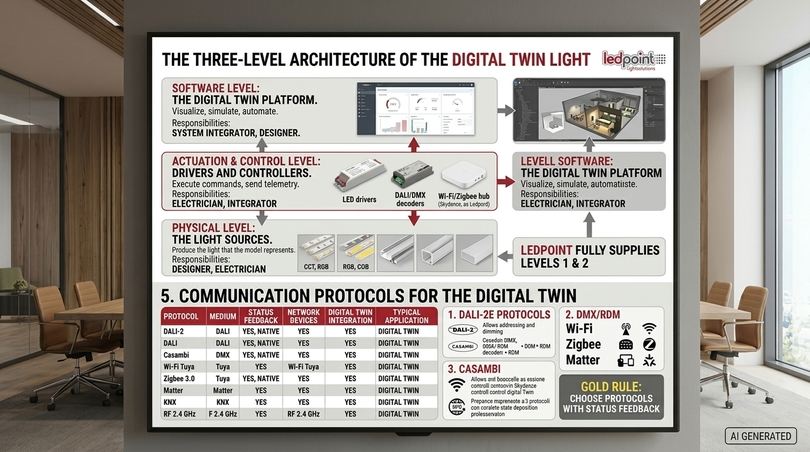
Physical level: the light sources
The first level is the visible one: monochromatic, CCT (dynamic white), RGB, RGBW, RGB+CCT or COB LED strips, mounted in aluminum profiles with diffuser, as well as possible spotlights, bars or neon flex. In a digital twin, each light segment becomes an "object" with a unique identifier, a position in space, a length, a luminous flux per meter, a color temperature and an efficiency in lm/W.
The quality of the sources is decisive: if the declared photometric data do not match the real ones, the digital twin lies. For this reason, it is advisable to choose strips with certified data (for example LM-80 compliance on lumen maintenance) and with tight color binning, expressed in MacAdam steps, so that the simulated color and the real one match.
Actuation and control level: drivers and controllers
The second level is the operational heart. Here we find the power supplies (which provide constant voltage at 12, 24 or 48 V) and the controllers or decoders that regulate each channel via PWM. This level performs two fundamental functions for the digital twin: it executes commands (on, off, dim, change color) and returns status (current level, presence of faults, device online or offline).
The choice of protocol at this level determines the quality of the digital twin. A controller that only receives infrared commands from a remote control cannot communicate with software; a DALI-2, DMX with RDM, Wi-Fi Tuya or Zigbee controller can.
Software level: the digital twin platform
The third level is the platform that hosts the 3D model and the logic. It can be a BMS (Building Management System), an IoT middleware based on protocols such as MQTT, a BIM environment such as Revit with monitoring plug-ins, or a real-time graphics engine such as Unreal Engine or Unity. This level queries the gateways via IP network, updates the 3D scene and sends commands.
| Level | Components | Function in the digital twin | Who handles it |
|---|---|---|---|
| 1. Physical | LED strips, profiles, diffusers, spotlights | Produce the light that the model represents | Designer, electrician |
| 2. Actuation and control | Power supplies, controllers, DALI/DMX decoders, Wi-Fi/Zigbee hubs | Execute commands, send telemetry | Electrician, integrator |
| 3. Software | BMS, IoT middleware, BIM, 3D engines | Visualize, simulate, automate | System integrator, designer |
Ledpoint fully supplies levels 1 and 2: LED sources, profiles, power supplies and the entire ecosystem of controllers and decoders Skydance lighting control systems. Level 3 is chosen according to the project and can be implemented with third-party software that connects to the open protocols supported by the hardware.
5. Communication protocols for the digital twin: DALI-2, DMX/RDM, Casambi, Zigbee, Matter, KNX
The protocol is the language with which the digital twin speaks to the system. Choosing it badly means having a digital twin that is "deaf" or "mute". In this section we analyze the most widespread protocols, their strengths and the type of project for which they are suitable, with particular attention to the ability to provide bidirectional feedback.
DALI-2: the professional standard with status feedback
DALI-2 (Digital Addressable Lighting Interface, standard IEC 62386) is the reference protocol for professional lighting. On a DALI line it is possible to address up to 64 control devices and 16 groups, and each device can respond to queries about its status: current level, presence of lamp or driver faults, operating hours depending on the model. It is the ideal choice for the digital twin in offices, shops and hotels because feedback is native and standardized, and because DALI-2 introduces interoperability certification between different manufacturers.
Advantages of DALI-2 for the digital twin
The non-polarized two-wire bus is simple to wire, tolerates free topologies and allows groups and scenes to be modified via software without touching the cables. Through DALI-IP or DALI-KNX gateways the line connects to the building network and therefore to the digital twin software.
DMX512 and RDM: entertainment precision applied to architecture
DMX512 originated in the entertainment world and manages up to 512 channels per universe with very fast updates, ideal for dynamic RGB effects and media facades. Pure DMX is one-way, but with the RDM extension (Remote Device Management) decoders can be addressed remotely and return status information, making them suitable for a digital twin of dynamic windows, showrooms and scenic installations.
Casambi: Bluetooth Mesh without construction work
Casambi uses a Bluetooth Mesh network in which each node repeats the signal of the others. It is very popular in shop and restaurant retrofits because it does not require signal cables. Through the platform's cloud APIs, the operating status of devices can be read by external software and synchronized with a 3D model. It is an excellent solution when construction work must be kept to a minimum.
Wi-Fi Tuya, Zigbee 3.0 and Matter: accessible IoT
Wi-Fi controllers compatible with the Tuya/Smart Life ecosystem communicate with the cloud and, through the Tuya development APIs, allow external software to read the status of each zone and send commands. Zigbee 3.0 creates a low-power mesh network managed by a hub, while Matter is the new home interoperability standard. They are the most convenient choices for the residential digital twin and for small commercial businesses, and are very popular with home automation enthusiasts because they integrate with voice assistants and platforms such as Home Assistant.
KNX, Modbus and CAN: integration with building automation
KNX is the European standard (EN 50090) for building automation; Modbus and CAN bus are widespread in industrial environments. Power supplies and gateways equipped with these interfaces connect directly to the building BMS, transmitting electrical parameters and diagnostics. In a complex commercial project it is common to combine multiple protocols: DALI-2 for general lighting, DMX for scenic effects, KNX as the integration backbone.
Comparison table of protocols for the digital twin
| Protocol | Medium | Status feedback | Devices per network | Digital twin integration | Typical application |
|---|---|---|---|---|---|
| DALI-2 | 2-wire bus | Yes, native | 64 per line | DALI-IP / KNX gateway | Offices, retail, hotels |
| DMX512 + RDM | Balanced cable (XLR/RJ45) | Yes, with RDM | 512 channels per universe | Art-Net / sACN over IP | Dynamic windows, facades, showrooms |
| Casambi | Bluetooth Mesh | Yes, via cloud | Dozens or hundreds of nodes per network | Cloud API | Retrofit, restaurants, shops |
| Wi-Fi Tuya | 2.4 GHz Wi-Fi | Yes, via cloud | Limited by the router | Cloud REST API | Residential, small retail |
| Zigbee 3.0 | 2.4 GHz radio mesh | Yes | Dozens-hundreds per hub | Hub/gateway, Home Assistant | Home automation, small offices |
| Matter | IP (Wi-Fi/Thread) | Yes | Depends on the controller | Open local standard | Interoperable smart home |
| KNX | Bus, IP, radio | Yes | Thousands with couplers | KNX-IP, BMS | Tertiary buildings, large residences |
| Proprietary 2.4 GHz RF | Radio | No | Remote-control zones | Only via converter | Simple local control |
The golden rule: for a digital twin, always choose a protocol that returns status. If the existing system is based on 2.4 GHz RF, there are bridge devices that connect it to Wi-Fi or DALI-2, as we will see in the products section.
6. Ledpoint products for the lighting digital twin
Theory and protocols are of little use without reliable hardware. In this section we present a selection of products for lighting simulation and for the digital twin available in the Ledpoint.it catalog, chosen because they cover the physical and control levels of the digital twin. For each one we explain what it does, why it is useful in a digital twin project and in which situations it should be used.
LED strip 3000K 2835 240 led/m 24V: the reliable "pixel" of light

The 5 m warm white 3000K 3-step 2835 240 led/m 24V 14.4 W/m LED strip is a good example of a source "for digital twins". It declares 2000 lm/m with 155 lm/W efficiency, 3-step MacAdam color binning, LM-80 compliance, 24 V power supply, cut every 3.33 cm and 1200 LEDs over 5 meters. For the digital twin these numbers are valuable: each meter of strip becomes an object with known flux, power and color, which the 3D model can simulate accurately and the controller can regulate in PWM.
The high density of 240 LEDs/m avoids the dotted effect even in shallow profiles, so the real result matches the continuous linear rendering of the model. The 24 V voltage reduces voltage drops over long runs, an aspect that the digital twin can monitor indirectly by comparing the expected flux with the one perceived by sensors. In the same family there are also versions with 120 led/m and, for those who want dynamic white manageable by the digital twin, the entire range of CCT LED strips and Circadian Light strips, ideal for simulating and applying circadian light cycles.
Aluminum profiles: the housing that makes simulation faithful

In the digital twin, what matters is the light coming out of the profile, not the light emitted by the bare LED. A 44x12 mm plasterboard aluminum profile integrates the light line into the ceiling, dissipates heat (extending the useful life of the strip and keeping flux constant) and, with the diffuser, creates a homogeneous linear source that is easy to model. Remember to include the diffuser transmittance in the model: an opal diffuser can absorb a significant part of the flux, and this must be considered in the lighting calculation. For exposed solutions, the 17x8 mm profile and the 16 mm angular profile are widely used, while the entire range is in the aluminum profiles category.
SK-WT5 Wi-Fi and 2.4G RF controller: the bridge between system and cloud

The SK-WT5 Wi-Fi and 2.4G RF controller is a 5-in-1 receiver for RGB+CCT, RGBW, RGB, CCT and monochromatic strips. It works at 12-24 V, manages 5 channels at 3 A (up to 15 A total, 180-360 W), with constant-voltage PWM output, operating temperature from -30 °C to +55 °C and compact dimensions of 114x38x20 mm. It is controlled via the Tuya/Smart Life app, Amazon Alexa and all 2.4G RF remote controls in the family.
For the digital twin, the WT5 has a valuable feature: it also works as a Wi-Fi-RF converter, so it can bring one or more already installed RF controllers into the cloud. In practice it allows an existing system to be "digitized" without replacing everything, and makes the status of zones readable by software through the Tuya cloud. It is the ideal solution for the homeowner who wants maximum control, for the home automation enthusiast and for the small shop that wants to start experimenting. In the same family there is the SK-WT1 controller for monochromatic and CCT strips with push dim input.
Technical note: as indicated in the product data sheet, very crowded Wi-Fi networks can reduce range; if the button cables run near 230 VAC, shielded cables should be used.
SK-WG-Z Wi-Fi, Zigbee and Bluetooth home automation hub: the multiprotocol gateway

The SK-WG-Z Wi-Fi, Zigbee and Bluetooth home automation hub is the gateway that collects the Zigbee devices of the home or premises and brings them onto the network. In a digital twin it plays the role of telemetry collection point: a single IP node through which the software can query all controllers and sensors on the mesh network. It is particularly suitable for those who want to combine lights, presence and motion sensors and automatic scenes, and for those who use Ledpoint's ZigBee controllers category.
SK-DA-M(WT) Wi-Fi and RF to DALI-2 master converter: the digital twin enters the professional bus

The 4-channel SK-DA-M(WT) Wi-Fi and RF to DALI-2 master converter is a strategic device for those designing a digital twin in the commercial sector. It works as a DALI-2 master: it sends commands to the DALI line and, at the same time, can be reached via Wi-Fi through an app and cloud, as well as via 2.4G RF remote controls. This means that an entire DALI-2 line can be governed and supervised remotely, with all the advantages of the professional protocol (addressing, groups, scenes, feedback) and the simplicity of an app.
It is the perfect solution for the shop or professional studio that wants a robust DALI-2 system without investing in a complete BMS, and for the integrator who wants a quick bridge between the DALI line and their digital twin middleware.
SK-DA-PL DALI-2 bus power supply and repeater: the basis of every DALI line

Every DALI line requires bus power. The SK-DA-PL DALI-2 bus power supply and repeater provides this power and, as a repeater, allows the line to be extended in large systems. For the electrician it is a component to always include in the estimate: forgetting it is one of the most common mistakes in early DALI systems. In a digital twin, bus stability is fundamental, because an unstable bus produces inconsistent telemetry.
SK-DH4 DALI/DMX decoder and SK-D4-XE DMX512 & RDM decoder

The SK-DH4 DALI/DMX decoder with 4 channels at 8 A, with integrated 100-240 VAC power supply, receives DALI or DMX commands indifferently and drives the LED strips. The dual compatibility is a huge advantage in mixed projects: the same decoder family can work on the office DALI line and in the shop window DMX universe, simplifying stock, wiring and mapping in the digital twin.

The SK-D4-XE DMX512 & RDM decoder with 4 channels at 8 A and XLR3 and RJ45 ports supports the RDM standard, i.e. bidirectional remote management of DMX devices. In a digital twin this means being able to automatically discover the decoders present on the line, assign addresses remotely and read their status, instead of configuring them one by one with physical selectors. For facades, dynamic windows, showrooms and installations it is a valuable tool. The complete range is in the DMX and DALI decoders category.
Smart and constant-voltage power supplies
The actuation layer is completed by power supplies. Ledpoint offers 24V and 48V power supplies for LED strips, the smart power supplies category with integrated control interfaces and the 230V anti-flicker drivers. Power supplies with DALI-2 or KNX interface, such as those in MEAN WELL's professional series, allow the digital twin to also receive electrical parameters and driver diagnostics, a very useful level of detail in predictive maintenance.
Summary table of Ledpoint products for the digital twin
| Product | Level | Protocol | Key data | Role in the digital twin | Ideal for |
|---|---|---|---|---|---|
| 3000K 2835 240 led/m 24V strip | Physical | PWM (via controller) | 2000 lm/m, 155 lm/W, 14.4 W/m, 3-step | Source with reliable photometric data | Retail, hospitality, residential |
| 44x12 mm plasterboard profile | Physical | - | Flush integration in ceiling | Homogeneous and modelable light line | Offices, shops, homes |
| SK-WT5 controller | Control | Wi-Fi Tuya + 2.4G RF | 5 channels x 3 A, 12-24 V | Cloud bridge, Wi-Fi-RF converter | Smart home, small retail |
| SK-WG-Z hub | Control | Wi-Fi, Zigbee, Bluetooth | Multiprotocol gateway | Mesh network telemetry collection | Home automation, small offices |
| SK-DA-M(WT) converter | Control | Wi-Fi + RF → DALI-2 master | 4 channels, 24 V DC | Remote supervision of DALI-2 line | Shops, studios, hotels |
| SK-DA-PL bus power supply | Control | DALI-2 | Bus power and repetition | Line and data stability | Every DALI system |
| SK-DH4 decoder | Control | DALI / DMX | 4 channels x 8 A, 100-240 VAC | Universal actuator for mixed projects | Retail, offices |
| SK-D4-XE decoder | Control | DMX512 + RDM | 4 channels x 8 A, XLR3 and RJ45 | Remote addressing and feedback | Windows, facades, showrooms |
7. The 5 operational phases for creating a lighting digital twin
Now that we know the architecture, protocols and components, we can look at the concrete process. The five phases that follow represent the method we recommend to designers, electricians and integrators to move from a paper project to an operational digital twin. Each phase has a precise, verifiable output that becomes the input of the next.
Phase 1: virtual modeling of the space
It starts with the creation of the three-dimensional model of the space, preferably in a BIM environment (for example Revit or ArchiCAD exported in the open IFC format), or directly in a 3D engine such as Unity or Unreal. Each surface must have its reflectance: a light oak floor, a matte white ceiling and an exposed concrete wall return very different amounts of light.
Mapping the light points
Each LED strip or fixture is identified with a unique code (ID) that will accompany it throughout the life of the system, on the model, on the electrical diagram, on the physical label and in the control software. The ID is associated with position, length, flux per meter, color temperature, dimming curve and planned control channel. This correspondence table is the true DNA of the digital twin.
Phase 2: installation of the hardware infrastructure
On site, the electrician connects the LED strips, inserted in the profiles, to the constant-voltage power supplies and zone controllers. The choice of controllers follows the topology defined in the project: DALI-2 with decoders such as the SK-DH4 and a master such as the SK-DA-M(WT) for general lighting; DMX with RDM with decoders such as the SK-D4-XE for windows and scenic effects; Wi-Fi or Zigbee with the SK-WT5 controller or the SK-WG-Z hub for simpler areas or residential use; Casambi for retrofits without new signal cables.
Installation best practices
Label each cable with the ID from phase 1, respect conductor cross-sections to limit voltage drops, separate signal cables from power cables or use shielded cables, size power supplies with at least 20% margin and photograph every panel and every junction box before closing: those photos will become part of the digital twin documentation.
Phase 3: configuration and addressing of the control network
Once the hardware is installed, it is time for addressing. On DALI-2, short addresses are assigned to devices (up to 64 per line), groups are created and scenes are stored. On DMX, starting addresses are assigned to each decoder, remotely if the decoder supports RDM. On Wi-Fi and Zigbee networks, devices are associated with the app and gateway; on Casambi, the Bluetooth Mesh network is created via the dedicated app.
The critical point is making network addresses match the IDs in the model. A DALI address 17 must correspond exactly to strip "VET-03" in the 3D model. A shared spreadsheet between electrician and integrator, updated in real time, avoids most errors.
Phase 4: software integration and bidirectional synchronization
This is the phase in which the model truly becomes a digital twin. The middleware (an IoT server, a BMS or a gateway) connects the physical network to the 3D model via IP and manages two flows.
From virtual to real: commands
The central software sends dimming instructions (0-100%), color temperature or RGBW color to the controllers via cloud APIs (for example Tuya or Casambi) or via network gateways (DALI-IP, KNX-IP, Art-Net/sACN for DMX).
From real to virtual: telemetry
DALI-2, DMX/RDM and Wi-Fi controllers return the real operating status: current dimming level, on/off, device online or offline and any faults. The 3D model updates accordingly, showing the light exactly as it is in reality at that moment.
Phase 5: calibration and real-time rendering
The last phase closes the loop. With a lux meter, real illuminance is measured at control points and compared with the simulated values; the differences are used to correct reflectances and maintenance factors in the model. From that moment on, the synchronized photometric rendering becomes reliable and the digital twin can be used to simulate new scenarios, circadian cycles, different opening hours or seasonal configurations, assessing their visual and energy impact before applying them on site.
| Phase | Main activities | Output | Responsible | Ledpoint products involved |
|---|---|---|---|---|
| 1. Modeling | 3D model, reflectances, ID mapping | ID-position-photometry table | Designer | Technical data for strips and profiles |
| 2. Installation | Strips, profiles, power supplies, controllers | Wired and labeled system | Electrician | Strips, profiles, power supplies, decoders |
| 3. Configuration | DALI/DMX addressing, Wi-Fi/Zigbee networks | Address map = ID map | Electrician, integrator | SK-DA-M(WT), SK-DA-PL, SK-D4-XE, SK-WG-Z |
| 4. Integration | Middleware, APIs, IP gateways | Bidirectional data flow | Integrator | SK-WT5, SK-WG-Z, SK-DA-M(WT) |
| 5. Calibration | On-site measurements, model correction | Validated digital twin | Designer, integrator | The entire system |
8. Lighting calculation: lux, lumens and standards in the digital twin
A digital twin is credible only if the numbers are correct. In this section we review the fundamental quantities, explain the difference between lux and lumens, recall the regulatory requirements and propose a complete calculation example, developed by the Ledpoint technical team, for a medium-sized retail store.
Lux and lumens: the difference everyone must know
The lumen (lm) measures luminous flux, i.e. how much light a source emits in total. The lux (lx) measures illuminance, i.e. how much light reaches a surface: 1 lux equals 1 lumen distributed over 1 square meter. The conversion between lux and lumens is therefore not a simple fixed factor: it depends on the area, distance, optics and reflections of the environment. This is exactly what lighting simulation calculates, and what the digital twin verifies over time.
| Quantity | Unit | What it measures | Role in the digital twin |
|---|---|---|---|
| Luminous flux | lumen (lm) | Total emitted light | Property of each light object |
| Illuminance | lux (lx) | Light received per m² | Result to be verified against standards and measurements |
| Luminous efficiency | lm/W | Light produced per watt | Consumption and energy class calculation |
| Color temperature | kelvin (K) | White tone | Scenes, circadian cycles |
| Color rendering | CRI (Ra) | Color fidelity | Perceived quality of displayed products |
| Glare | UGR | Visual discomfort | Workstation comfort verification |
| Uniformity | U0 (Emin/Em) | Light homogeneity | Regulatory verification |
The requirements of EN 12464-1
The EN 12464-1 standard establishes lighting requirements for indoor workplaces, with maintained illuminance values, uniformity, maximum UGR and minimum color rendering for each visual task. For example, for retail sales areas the standard typically indicates 300 lx, while for checkouts and counters the requirement rises to 500 lx; in offices, writing and reading workstations require 500 lx with UGR not exceeding 19. Values and requirements must always be verified against the current edition of the standard, but the principle is clear: the digital twin must demonstrate compliance with these values not only at commissioning, but throughout the life of the system, taking actual dimming into account.
Ledpoint lighting calculation example: 120 m² shop
Here is a concrete example, developed by our technical team, showing how to move from the regulatory requirement to the number of meters of strip and the sizing of power supplies and controllers. It is the same calculation that a digital twin performs and verifies automatically.
Starting data
Sales area of 12 x 10 m (120 m²), height 3 m, white ceiling, light walls, medium floor. Target: 300 lx maintained on the walking surface. Estimated utilization factor 0.60, maintenance factor 0.80. Source: 3000K 2835 240 led/m 24V strip with 2000 lm/m in a plasterboard profile with opal diffuser, estimated transmittance 85%.
Calculation of required flux (total flux method)
Required flux = E x A / (CU x MF) = 300 x 120 / (0.60 x 0.80) = 36,000 / 0.48 = 75,000 lm.
Useful flux per meter of strip in the profile = 2000 x 0.85 = 1700 lm/m.
Meters of strip required = 75,000 / 1700 = approximately 44 m.
Power, power supplies and controllers
Installed power = 44 m x 14.4 W/m = approximately 634 W, equal to a power density of approximately 5.3 W/m². Total current at 24 V = 634 / 24 = approximately 26.4 A. With a 20% margin, approximately 760 W of power supply is needed, for example divided over two 400 W power supplies, each dedicated to two zones. For DALI-2 control, a 4-channel 8 A decoder such as the SK-DH4 is sufficient to manage 4 independent zones (entrance, central area, display walls, checkout), plus the SK-DA-PL bus power supply and an SK-DA-M(WT) master for remote supervision.
| Parameter | Value | Notes |
|---|---|---|
| Area | 120 m² | 12 x 10 m |
| Target illuminance | 300 lx | Sales area, verify current standard |
| Total required flux | 75,000 lm | CU 0.60, MF 0.80 |
| Useful flux per meter | 1700 lm/m | 2000 lm/m x 85% diffuser |
| Meters of strip | 44 m | About 9 reels of 5 m |
| Installed power | 634 W | 14.4 W/m |
| Power density | 5.3 W/m² | Very efficient value for retail |
| Current at 24 V | 26.4 A | Distributed over 4 channels |
| Recommended power supply | 2 x 400 W | 20% margin |
| Control | DALI-2, 4 zones | SK-DH4 + SK-DA-PL + SK-DA-M(WT) |
The advantage of the digital twin emerges at this point: the model does not stop at saying "44 m are needed". It can show in real time that, with afternoon natural light, the window area still reaches 300 lx at 55% dimming, and therefore can schedule an automatic reduction without dropping below the regulatory value.
Essential glossary of the lighting digital twin
For those approaching the digital twin for the first time, here are the terms that recur most often in specifications, data sheets and project meetings. Knowing them allows you to talk with designers, integrators and suppliers without ambiguity.
| Term | Meaning | Why it matters in the digital twin |
|---|---|---|
| Digital twin | Virtual replica synchronized with a physical system | It is the final goal of the project |
| Digital shadow | Model that receives data but does not send commands | First step toward the complete digital twin |
| Telemetry | Status data sent from the field to the software | Feeds the digital twin in real time |
| Status feedback | Controller response on the real level | Without feedback the digital twin is blind |
| Middleware | Software that connects the physical network and the model | Translates protocols for the digital twin |
| IP gateway | Bridge between field bus and Ethernet network | Brings DALI, KNX or DMX into the digital twin |
| Maintenance factor | Expected reduction of flux over time | The digital twin updates it with real data |
| Daylight harvesting | Regulation based on natural light | Energy-saving function managed by the digital twin |
| IES / LDT file | Photometric description of a luminaire | Basis of lighting simulation in the digital twin |
| Scene | Stored set of levels and colors | Designed in the digital twin and sent to the field |
Keeping this glossary handy helps write clear specifications: specifying "controller with status feedback compatible with digital twin integration" is much more effective than a generic "dimmable controller". Technical detail in the specification reduces change orders during construction and ensures that the installed hardware is truly capable of communicating with the chosen platform.
9. Tools and software for lighting simulation
One of the most frequent questions concerns software. Which are the most used lighting programs and which lighting simulation tools are suitable for becoming the basis of a digital twin? There is no single answer: two tools are often used in sequence, one for calculation and one for real-time management.
Lighting calculation software
DIALux evo and ReluxDesktop are the reference programs for lighting calculation and are available free of charge. They allow models to be imported, photometric files to be loaded, illuminance, uniformity and UGR to be calculated, and regulatory verification documentation to be produced. They are the natural starting point for phase 1 of the digital twin, when the designer must decide how many meters of strip are needed and where to position them.
BIM environments
BIM environments such as Revit or ArchiCAD contain the complete geometry of the building and can host information about fixtures (ID, power, channel, protocol). By exporting in IFC format, the model becomes interoperable with facility management and digital twin platforms.
Real-time 3D engines and IoT platforms
Unity, Unreal Engine and platforms such as NVIDIA Omniverse offer realistic real-time rendering and can be connected to MQTT brokers or REST APIs. They are the choice for the most immersive digital twins, for example in showrooms or projects where the client wants to "walk" through the virtual space. For simpler installations, open-source platforms such as Home Assistant or Node-RED allow dashboards and automations to be built starting from Wi-Fi and Zigbee controllers.
| Tool | Category | Use in the digital twin | Indicative cost | Skill level |
|---|---|---|---|---|
| DIALux evo | Lighting calculation | Phase 1: sizing and standard verification | Free | Medium |
| ReluxDesktop | Lighting calculation | Phase 1: calculation and rendering | Free | Medium |
| Revit / ArchiCAD | BIM | Building model and fixture data | Professional license | High |
| Unity / Unreal Engine | Real-time 3D engine | Synchronized immersive visualization | Free / royalty-based | High |
| NVIDIA Omniverse | Simulation platform | Industrial and complex digital twins | Variable | Very high |
| Home Assistant | Home automation platform | Wi-Fi/Zigbee dashboards and automations | Free (open source) | Medium |
| Node-RED + MQTT | IoT middleware | Data integration and logic | Free (open source) | Medium-high |
| Commercial BMS | Building management | Whole-building supervision | License | High |
Practical advice: start with lighting calculation in DIALux or Relux, choose hardware with open protocols and only then decide which software platform to adopt. A well-made system, with controllers that return status, can be connected to any platform even later; a system with "mute" controllers cannot.
10. Applications of the digital twin in complex commercial projects
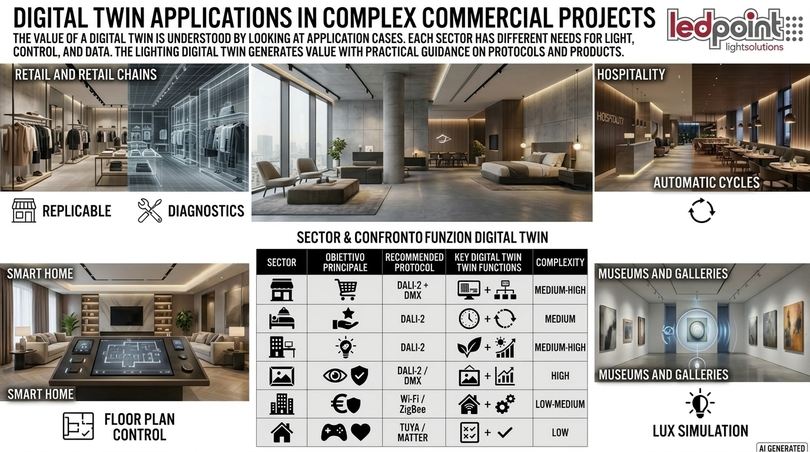
The value of a digital twin is truly understood only by looking at application cases. Each sector has different needs for light, control and data, and the digital twin adapts to each specifically. Let's look at the contexts in which the lighting digital twin generates the most value, with practical indications on protocols and products.
Retail and shop chains
In retail, light sells. A well-lit window attracts attention, a 4000 K white enhances technology products, a 3000 K makes clothing more welcoming. With a digital twin the chain can design a lighting standard in the model and replicate it identically across dozens of stores, remotely verifying that each shop complies with scenes, hours and levels. If in one store a zone is off or a decoder goes offline, the digital twin reports it before the customer notices.
Recommended configuration
DALI-2 for general lighting with SK-DH4 decoders, DMX with RDM for dynamic windows with SK-D4-XE decoders, high-density 24 V strips in recessed profiles, and supervision via SK-DA-M(WT) master or DALI-IP gateway toward the chain's digital twin.
Hotels, restaurants and hospitality
In hospitality, light builds atmosphere and changes during the day: bright, fresh breakfast; neutral lunch; warm, soft dinner. The digital twin allows these cycles to be designed in the 3D model, their rendering verified in each room and programmed automatically. In guest rooms, the digital twin can integrate presence sensors and night courtesy light, reducing consumption in empty rooms. For retrofits of existing rooms, Casambi and Wi-Fi controllers make it possible to add control and telemetry without opening ceilings.
Offices and open spaces
In offices the goal is visual comfort in compliance with EN 12464-1, combined with energy savings. A digital twin connected to presence and natural light sensors implements so-called daylight harvesting: artificial light is automatically reduced when daylight comes through the windows, keeping illuminance on desks constant. With CCT LED strips or the Circadian Light line, the digital twin can also apply lighting that follows the natural rhythm of the day, cooler in the morning and warmer in the late afternoon.
Museums, galleries and exhibition spaces
In museums, light must enhance works without damaging them. The digital twin allows the cumulative light exposure of each work to be simulated (lux per annual exposure hours), unwanted reflections to be verified and the installation to be changed virtually before physically moving the projectors. The high color rendering of the sources and DALI-2 or DMX control with feedback are essential requirements.
Condominiums and common areas
For the condominium administrator, the digital twin takes a more pragmatic form: a digital map of the common-area lights (stairs, entrances, garages, gardens) with the status of each zone, operating hours and any faults. A solution based on Wi-Fi or Zigbee controllers with motion sensors allows lights to be turned on only when needed, notifications to be received in case of malfunction and savings achieved to be documented to residents. For outdoor or damp areas, it is advisable to choose controllers with adequate IP protection, such as the IP67 models in the LED strip controllers category.
High-end residential and smart home
Even a home can have its digital twin. For the owner who wants maximum control and for the technology enthusiast, a domestic digital twin is built with Wi-Fi controllers such as the SK-WT5, the SK-WG-Z Zigbee hub and a platform such as Home Assistant that shows the home plan with the status of each light. It is the simplest way to approach digital twin logic with a limited investment, possibly taking advantage of tax incentives for home automation and energy efficiency, to always be verified with your consultant according to current regulations.
| Sector | Main objective | Recommended protocol | Key digital twin functions | Complexity |
|---|---|---|---|---|
| Retail / chains | Replicable lighting standard, sales | DALI-2 + DMX/RDM | Scenes, multi-site supervision, diagnostics | Medium-high |
| Hospitality | Atmosphere, guest comfort | DALI-2, Casambi | Daily cycles, presence, retrofit | Medium |
| Offices | Visual comfort, savings | DALI-2, KNX | Daylight harvesting, circadian, standard | Medium-high |
| Museums | Conservation, enhancement | DALI-2, DMX/RDM | Cumulative exposure, virtual installations | High |
| Condominiums | Costs, reliability | Wi-Fi, Zigbee | Fault map, operating hours, sensors | Low-medium |
| Smart home | Total control, comfort | Wi-Fi Tuya, Zigbee, Matter | Live floor plan, scenes, voice | Low |
11. Energy savings and ROI of the digital twin
Every technological investment must demonstrate its return. The digital twin generates value on three fronts: energy saved, optimized maintenance and service quality. In this section we revisit the 120 m² shop example and calculate the energy savings achievable with intelligent management based on the digital twin.
Calculation of the system's energy consumption
The system sized in section 8 has an installed power of 634 W. Let's assume 12 hours of operation per day for 360 days per year. Consumption at full power is 0.634 kW x 12 h x 360 days = approximately 2739 kWh/year.
With the digital twin, time-based scenes, daylight harvesting on the zones near the window and reduction during low-traffic periods are applied. Assuming an average dimming level of 65% (with PWM dimming the absorbed power follows the set level approximately proportionally), consumption drops to approximately 2739 x 0.65 = approximately 1780 kWh/year. The saving is approximately 959 kWh/year; with an indicative energy cost of EUR 0.25/kWh, this corresponds to approximately EUR 240/year for a single store, to which are added the benefits for LED life, since operating at reduced power they heat up less and maintain flux longer.
| Item | Without digital twin | With digital twin | Difference |
|---|---|---|---|
| Installed power | 634 W | 634 W | - |
| Average operating level | 100% | 65% | -35% |
| Annual consumption | 2739 kWh | 1780 kWh | -959 kWh |
| Annual cost (EUR 0.25/kWh) | EUR 685 | EUR 445 | -EUR 240 |
| Fault diagnostics | On report | Automatic | Fewer stoppages |
| Maintenance interventions | Corrective | Scheduled | Fewer callouts |
The value you do not see on the bill
Energy savings are only the easiest part to calculate. Across a chain of 30 shops, direct savings exceed EUR 7,000/year, but the greatest value lies elsewhere: fewer technical callouts thanks to remote diagnosis, lighting scenes consistent across all stores, the ability to test a new installation in the digital twin without stopping the shop. For a multi-site company, a single avoided technical callout can be worth more than a year's energy savings.
How to measure return on investment
The digital twin itself is the best tool for measuring its own ROI. By collecting data on operating hours and dimming levels, it produces monthly energy reports, compares different periods and documents results for environmental certifications, sustainability reports or incentive applications. What is measured can be improved, and what is documented can be valued.
12. The digital twin for every professional: profile guide
The digital twin involves different figures, each with their own objectives. In this section we translate the digital twin into the language of each profile, with practical advice and reference products. Find yours and discover where to start.
For the electrician: reliability, safety and quick installation
For the electrician, the digital twin is not an abstract concept but a system to be installed well, quickly and without callbacks. The good news is that a system ready for the digital twin is no more difficult to implement than a traditional system: it simply requires more order. 24 V strips with frequent cutting, power supplies sized with margin, DALI-2 decoders with clear terminal blocks, a DALI bus power supply such as the SK-DA-PL and labeling consistent with the project IDs. The added value for the electrician is twofold: they can offer the customer a remote assistance service and can diagnose faults before going out, bringing the right spare part with them.
For the homeowner: maximum control
Those who want maximum control over their home find the most complete answer in the domestic digital twin. With a controller such as the SK-WT5 and the Tuya app, every light zone becomes manageable from a smartphone and voice assistant; with the SK-WG-Z hub, sensors and automations are added. The next step is seeing your home in plan view with the status of each light, scheduling warm evening light, simulating presence during holidays and monitoring consumption. All with reliable products, installed by a trusted electrician.
For the technology and home automation enthusiast
For those who love technology, the digital twin is an extraordinary playground. Wi-Fi and Zigbee controllers integrable with Home Assistant, MQTT brokers, Node-RED dashboards and, for the most ambitious, a 3D model of the home in Unity that updates in real time. The advice is to choose hardware with open, documented protocols, so as not to be tied to a single app and to let your digital twin evolve over time.
For the architect and interior designer
For those who design, the digital twin is a sales and quality tool. Presenting the space to the client in 3D with real light, letting them choose their preferred color temperature in the model and guaranteeing that the installed system will be identical is a very powerful commercial argument. Moreover, the digital twin allows new solutions to be proposed, such as circadian light or dynamic scenes, demonstrating their effect before the investment. The advice is to work with sources with reliable photometric data and with aluminum profiles that make the light line homogeneous and predictable.
For the condominium administrator
The administrator seeks convenient and durable solutions for monitoring lights. The digital twin of common areas, even in simplified form, offers an updated map of light status, notifications in case of failure, switching statistics and documentation of savings to present at the assembly. Wi-Fi or Zigbee controllers, motion sensors and efficient 24 V LED strips constitute an economical and robust base. The savings on operating hours of stairs and garages, combined with the reduction of on-call interventions, repays the investment in a reasonable time.
For the owner of an electrical materials store
For the retailer, the digital twin is an opportunity to expand the assortment toward higher value-added products. DALI-2 controllers, DMX decoders with RDM, multiprotocol hubs and Wi-Fi-DALI converters are items that installers request increasingly often, and that require technical consultancy capable of building customer loyalty among professionals. Offering "digital twin kits" by project type (shop, office, condominium, smart home) can become a distinctive element compared with generalist competitors. Ledpoint offers the professional channel a complete catalog and technical support to build these proposals.
| Profile | Objective | What the digital twin offers | Starting products |
|---|---|---|---|
| Electrician | Reliable, safe, quick-to-install products | Remote diagnosis, fewer callbacks, value-added assistance | 24V strips, SK-DH4, SK-DA-PL, power supplies |
| Homeowner | Maximum control | Live floor plan, scenes, consumption | SK-WT5, SK-WG-Z, CCT strips |
| Home automation enthusiast | Control lighting | Open integration, experimentation | SK-WT5, SK-WG-Z, ZigBee controllers |
| Architect / designer | Propose new solutions | Faithful 3D presentation, circadian light | Circadian Light strips, profiles, DALI-2 |
| Condominium administrator | Convenient and durable solutions | Fault map, savings reports | Wi-Fi/Zigbee controllers, sensors, 24V strips |
| Electrical materials store | Expand the assortment | Digital twin kits by type | Entire controller and decoder range |
13. Mistakes to avoid and project checklist for the digital twin
The experience gained by the Ledpoint technical team in assisting installers and designers shows that most problems in digital twin projects do not arise from technology, but from organization. Here are the most frequent mistakes and a practical checklist to avoid them.
The eight most common mistakes
1. Choosing controllers without feedback
Controllers that only receive RF or IR commands cannot communicate status to the digital twin. If the system already exists, use a converter such as the SK-WT5 or SK-DA-M(WT) to bring it into the digital world.
2. Not matching IDs and addresses
If DALI address 17 does not correspond to strip "VET-03" in the model, the digital twin will show incorrect information. A single shared correspondence table is essential.
3. Forgetting DALI bus power
Without a bus power supply such as the SK-DA-PL, the DALI line does not work or works unstably, with inconsistent telemetry.
4. Using unreliable photometric data
If the declared flux of a strip is overstated, the lighting simulation and the digital twin will be optimistic. Choose sources with certified data and consider the transmittance of diffusers.
5. Undersizing power supplies
Power supplies at the limit heat up, reduce useful life and can cause flicker that the model does not predict. Keep at least 20% margin.
6. Neglecting voltage drops
On long runs, low-voltage strips lose brightness at the end. Use 24 V or 48 V, feed from both sides or at multiple points and size cables correctly.
7. Mixing signal and power cables
Interference on DMX signals or button lines can generate incorrect commands. Physical separation or shielded cables are the solution.
8. Not calibrating the model with real measurements
An uncalibrated digital twin is just a nice animation. A few measurement points with a lux meter turn the model into a reliable tool.
Project checklist
| No. | Check | Phase | Done |
|---|---|---|---|
| 1 | Illuminance targets defined according to EN 12464-1 | Design | ☐ |
| 2 | Lighting calculation performed with DIALux or Relux | Design | ☐ |
| 3 | Protocol with status feedback chosen for each zone | Design | ☐ |
| 4 | ID-position-channel-address table completed | Design | ☐ |
| 5 | Power supplies sized with 20% margin | Installation | ☐ |
| 6 | DALI bus power supply included | Installation | ☐ |
| 7 | Cables labeled with project IDs | Installation | ☐ |
| 8 | Addresses assigned and verified on the model | Configuration | ☐ |
| 9 | Bidirectional data flow tested zone by zone | Integration | ☐ |
| 10 | Measurements with lux meter and model calibration | Commissioning | ☐ |
14. The future of digital twins in lighting: 2026-2030 trends
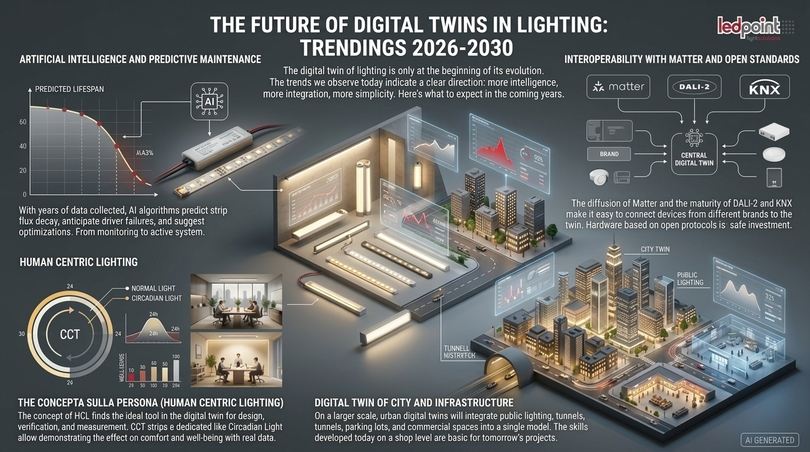
The lighting digital twin is only at the beginning of its evolution. The trends we observe today point in a clear direction: more intelligence, more integration, more simplicity. Here is what to expect in the coming years.
Artificial intelligence and predictive maintenance
With years of data collected by the digital twin, artificial intelligence algorithms will be able to predict the flux depreciation of each strip, anticipate driver failures and suggest the most efficient scenes based on actual footfall. The digital twin will move from a monitoring tool to a system that proposes optimizations.
Interoperability with Matter and open standards
The spread of Matter and the maturity of DALI-2 and KNX will make it increasingly easy to connect devices from different brands to the same digital twin. Hardware based on open protocols is the safest investment because it will remain compatible with future platforms.
Human-centric light
The concept of Human Centric Lighting, i.e. lighting that supports the circadian rhythm, will find in the digital twin the ideal tool to be designed, verified and measured. CCT strips and dedicated lines such as Circadian Light, managed by the digital twin, will make it possible to demonstrate with real data the effect of light on comfort and well-being.
Digital twins of cities and infrastructure
On a larger scale, urban digital twins will integrate public lighting, tunnels, car parks and commercial spaces into a single model. The skills developed today on a shop or a condominium are the basis for participating in tomorrow's projects.
15. Frequently asked questions about the digital twin and lighting simulation
We have collected the questions most often asked by installers, designers and end customers about the lighting digital twin. Click each question to read the answer.
What is a digital twin in lighting?A lighting digital twin is the virtual copy of a real light system, connected to it by a bidirectional data flow. The 3D model receives the status of each LED strip and controller, displays it and can send on/off, dimming and color commands, allowing the system to be simulated, managed and maintained. |
What is the difference between lighting simulation and a digital twin?Lighting simulation calculates illuminance and consumption in an ideal, static condition during design. The digital twin uses the same model but connects it to the real system: it reads the actual status of the devices, verifies values over time and sends commands. Simulation is a photograph; the digital twin is a continuous film. |
Which protocol should be chosen for a digital twin in a shop?For a shop, the most suitable protocol is DALI-2, because it offers standardized addressing, groups, scenes and status feedback. For dynamic windows, DMX with RDM is added. Products such as the SK-DH4 decoder, the SK-DA-PL bus power supply and the SK-DA-M(WT) master from Ledpoint cover this configuration. |
Can I turn an existing LED system into a digital twin?Yes, in most cases. If the system uses 2.4G RF controllers, a device such as the SK-WT5 controller, which also works as a Wi-Fi-RF converter, brings it into the cloud. For existing DALI lines, a gateway or a master with Wi-Fi connectivity is sufficient. Casambi is ideal for retrofits without new cables. |
Which software is needed for light simulation and the digital twin?For lighting calculation, DIALux evo or ReluxDesktop are used, both free. For the building model, BIM environments such as Revit are used. For the real-time digital twin, 3D engines such as Unity or Unreal, MQTT-based IoT middleware, commercial BMS or, in residential settings, Home Assistant are used. |
How much can be saved with a lighting digital twin?It depends on the project and operating hours. In our example of a 120 m² shop with 634 W installed, bringing the average operating level to 65% reduces consumption from approximately 2739 to 1780 kWh/year, saving approximately EUR 240 per year per store, in addition to benefits for maintenance and LED life. |
Is the digital twin useful for a private home too?Yes. A domestic digital twin is created with Wi-Fi controllers such as the SK-WT5, a Zigbee hub such as the SK-WG-Z and a platform such as Home Assistant that shows the floor plan with the status of each light. It allows maximum control, automatic scenes, presence simulation and consumption monitoring with a limited investment. |
How many devices can be connected to a DALI-2 line?A DALI-2 line according to IEC 62386 supports up to 64 individually addressable control devices, organized into 16 groups and with stored scenes. For larger systems, multiple lines are used coordinated by a gateway. Each line requires a bus power supply, such as the SK-DA-PL available on Ledpoint.it. |
From design to living light
The digital twin represents the natural evolution of lighting simulation: no longer a calculation to be archived after commissioning, but a living model that accompanies the system throughout its life, making it measurable, controllable and improvable. For complex commercial projects it means replicable lighting standards, remote diagnostics, documented energy savings and the ability to test every change virtually before applying it in reality.
The key to success lies in a choice made at the beginning: LED sources with reliable data, correctly sized power supplies and controllers with open protocols and status feedback. On Ledpoint.it you will find all the components of the physical and control levels, from 24V LED strips to aluminum profiles, up to the entire range of DALI and DMX decoders and LED strip controllers. To learn more, also consult our guide to LED strips for ceilings and the Ledpoint blog.
Do you have a project in mind? Download the Ledpoint catalogs with complete technical data or contact our technical office for advice on the configuration best suited to your digital twin and to receive a dedicated quote.
This article was developed with the support of artificial intelligence and subsequently reviewed, corrected and validated by the technical team of Ledpoint.it, which guarantees its reliability and compliance with official sources.