


Warm light: what it is, when to use it, and when to avoid it
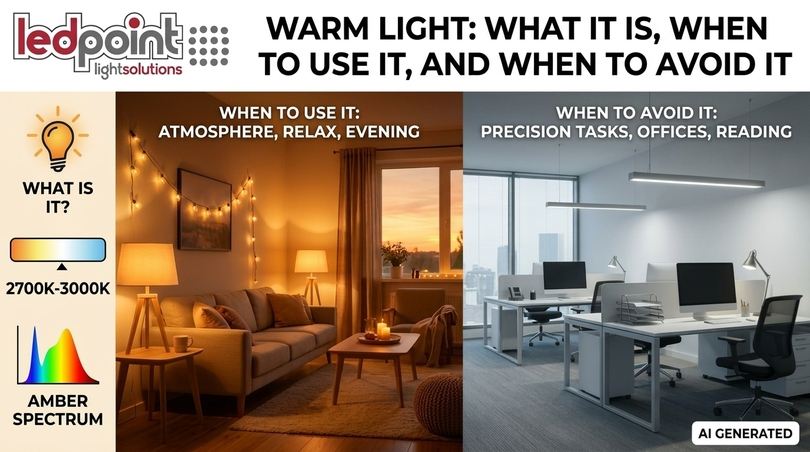
Warm light is a white light with a yellow-amber hue, with a colour temperature indicatively between 2200 and 3300 Kelvin (K). It recalls the flame of a candle or an incandescent bulb, creates cosy and relaxing atmospheres and is the ideal choice for living rooms, bedrooms, restaurant dining rooms and environments dedicated to relaxation.
You only need to walk into a restaurant at eight in the evening, sit in a living room after a day's work or open the door of a well-designed hotel room to realise it: warm light changes the way we perceive a space, the people in it and even the food on the plate. Yet, when the time comes to choose a bulb, a spotlight or an LED strip, many people stop in front of codes like 2700K, 3000K, 4000K or "warm white" without really knowing what they mean. The consequence is well known: kitchens that look like waiting rooms, bedrooms lit like a doctor's surgery, restaurants where the dishes appear dull.
In this guide, written by the Ledpoint technical team based on over fifteen years of experience in the production and distribution of LED strips, we set the record straight once and for all. We will look at the meaning of warm light, how to read the Kelvin scale, the difference between warm, cold (and natural) light, why warm light makes us feel good, when it is the wrong choice, how to use it room by room, how to light a restaurant and how to design a professional system. You will find tables, data measured on our strips, regulatory references and scientific studies. The goal is simple: to help you choose the right light the first time, without waste and without second thoughts.
In this article...
1. Warm light: meaning, colour and code
Before talking about rooms, restaurants and projects, it is worth establishing a common vocabulary. Many doubts about warm light actually stem from words used imprecisely: "warm" does not refer to the physical heat emitted by the source, "white" is not the opposite of "warm" and "natural" does not necessarily mean "like the sun". In this section we clarify the meaning of warm light, its actual colour and the codes under which you will find it indicated on packaging and in catalogues.
What warm light means
The expression warm light refers to a white light with a predominant component of yellow, orange and red wavelengths, and a reduced blue component. The term "warm" is perceptual and cultural: we instinctively associate these hues with fire, sunset, candlelight, and therefore with feelings of warmth and protection. It has nothing to do with the temperature of the lamp: a warm-light LED strip does not heat up more than a cold-light one; in fact, at the same power it dissipates practically the same heat.
Here lies the first paradox that confuses many people: in the physics of colour temperature, the light we call "warm" corresponds to a lower Kelvin number, while "cold" light corresponds to a higher number. The reason is linked to the behaviour of the black body, a theoretical object that, when heated, emits light first red, then yellow, then white and finally bluish. Warm light therefore corresponds to a black body that is "barely" heated, around 2700-3000 K; cold light to a black body that is much hotter, above 5000 K.
What colour is warm light
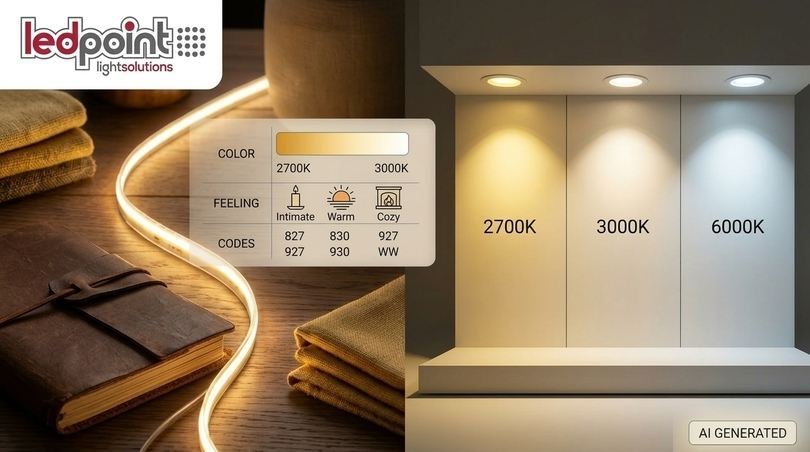
The colour of warm light is a white tending towards yellow-amber. At 2700 K it is similar to the classic 60 W incandescent bulb; at 3000 K it becomes a cleaner warm white, still cosy but less "yellow"; below 2500 K (2200 K, 2400 K) it approaches the colour of a candle and of vintage filament lamps, with a decidedly orange tinge. When someone asks "what colour is warm light?" the correct answer is therefore: not a single colour, but a family of warm whites ranging from amber to soft white.
What is the code for warm light
On the packaging of bulbs, spotlights and warm white LED strips, warm light is recognised by various labels. The most common are summarised in the following table.
| Code / label | Meaning | Typical temperature |
|---|---|---|
| WW (Warm White) | Warm white | 2700-3200 K |
| EWW / Extra Warm White | Extra warm white, candle effect | 2200-2500 K |
| Luce warm / warm light | Commercial term for warm light | 2700-3000 K |
| 827 | CRI 80 + 2700 K | 2700 K |
| 830 | CRI 80 + 3000 K | 3000 K |
| 927 / 930 | CRI 90 + 2700 K / 3000 K | 2700 / 3000 K |
| NW (Neutral White) / 840 | Natural white (NOT warm light) | 4000 K |
| CW (Cool White) / Cool Daylight / 865 | Cool white (NOT warm light) | 5500-6500 K |
The three-digit code is the most useful for a professional: the first digit indicates the colour rendering index (8 = CRI 80, 9 = CRI 90), the last two the colour temperature in hundreds of Kelvin. A "930" is therefore a warm light at 3000 K with a colour rendering above 90, the combination we recommend in most residential and restaurant environments.
Warm light and white light: are they the same thing?
One of the most frequent questions is "what is the difference between warm light and white light?". In a technical sense, warm light is a white light: all sources between about 2200 and 6500 K are considered white, because the eye perceives them as "normal" and not coloured light. In commercial language, however, "white light" is often used as a synonym for neutral (4000 K) or cold (6000 K) light, as opposed to "yellow" light. Ledpoint too, for clarity, organises its catalogue into three families: warm white 2200-3500 K, white 3800-5300 K and cool white 5500-8700 K. So the difference between warm white light and cool white light is only one of hue, not of nature.
2. The Kelvin scale: colour temperature of light explained simply
The colour temperature of bulbs and LEDs is measured in Kelvin, the unit of thermodynamic temperature. Knowing the Kelvin scale of LED light is the fundamental step to getting your purchase right: two strips with the same power and the same lumens can create completely different environments simply because one is at 2700 K and the other at 4000 K. In this section you will find the complete scale, the reference values of solar light and the concrete meaning of the most searched-for values.
The K scale of light: from candle to blue sky
The table below summarises the most common degrees Kelvin of light, with practical examples. It is the same one we use during technical consultations with installers and designers.
| Degrees Kelvin | Hue | Reference source | Sensation | Typical use |
|---|---|---|---|---|
| 1800-2000 K | Amber / orange | Candle flame | Intimate, romantic | Decoration, wine bars, candle effect |
| 2200-2500 K | Extra warm | Vintage filament lamp, sodium street lamps | Very enveloping | Hospitality, lounges, historic centres |
| 2700 K | Classic warm | Incandescent bulb | Domestic, relaxing | Living room, bedroom, evening restaurant dining room |
| 3000 K | Clean warm | Halogen | Cosy but crisp | Home, restaurants, hotels, fashion retail |
| 3500 K | Warm-neutral | "Warm white" fluorescent | Balanced | Kitchens, home offices, shops |
| 4000 K | Neutral / natural | Morning daylight | Clean, energising | Working kitchens, bathrooms, offices, schools |
| 5000 K | Cool white | Midday sun | Bright, technical | Laboratories, warehouses, colour matching booths |
| 6000-6500 K | Cold (cool daylight) | Overcast sky | Clinical, stimulating | Workshops, garages, industry |
| 9000-15000 K | Ice white | Clear blue sky | Scenographic | Aquariums, effects, sets |
A useful mnemonic rule: below 3300 K we speak of warm light, between 3300 and 5300 K of neutral or natural light, above 5300 K of cold light. This classification derives from the old European standard on fluorescent lamps and is still the most widely used reference in the industry today.
Colour temperature of solar light: the "natural" reference
When talking about natural light in Kelvin, you need to know that the sun does not have a fixed colour temperature. The temperature of solar light changes over the course of the day and with sky conditions, and it is precisely this variability that our body uses as a biological clock.
| Time / condition | Indicative colour temperature |
|---|---|
| Sunrise and sunset | 2000-3000 K |
| One hour after sunrise / before sunset (golden hour) | About 3500 K |
| Morning and afternoon with clear sky | 4500-5000 K |
| Summer midday | 5500-5800 K |
| Overcast sky | 6500-7500 K |
| Shade with blue sky | 8000-10000 K |
This scheme already explains, intuitively, why warm light works so well in the evening: it recreates the colour conditions of sunset, the moment when for millennia human beings stopped hunting and working to gather around the fire.
What kind of light is 2700K?
Light at 2700 Kelvin is warm: it is the hue closest to the old incandescent bulb, with an evident golden-yellow tinge. It is perfect for bedrooms, living rooms, dining rooms, lounges and evening restaurants. It enhances wood, leather, warm fabrics, earthy tones and skin tones. In the Ledpoint catalogue you will find it, for example, in the COB LED strip 2700K CRI Ra>90 400 LED/m 24V 11W/m, which produces 1030 lm/m with a continuous line of light, without dots.
What does 3000K mean? Is 3000K light warm or cold?
Light at 3000 K is warm light, but whiter and "cleaner" than 2700 K. It is the most widely used compromise in contemporary residential design and modern restaurant design: cosy without appearing yellow, crisp enough to read, cook at home or see the colours of dishes clearly. If you are wondering "what kind of light is 3000K?", think of a halogen lamp: warm, bright, elegant. It is the reference temperature of our best-selling strips, such as the 3000K 3step LED strip 240 LED/m 24V 14.4W/m (2000 lm/m, 155 lm/W).
What kind of light is 4000K? Warm or cold?
4000K light is neither warm nor cold: it is a neutral light, also called natural white. To the question "4000K warm or cold light?" the correct answer is therefore "neither". A 4000 Kelvin light appears white, bright, very similar to morning daylight. It promotes concentration and the perception of details, and is suitable for working kitchens, bathrooms, offices, studies, laboratories and service corridors. In relaxation environments, however, it can feel impersonal.
5000K light and 4200K light
5000 K light is cold: bright white, with a slight bluish tinge compared to 4000 K. It is used where maximum crispness is needed (colour control booths, laboratories, warehouses). 4200K light, on the other hand, is a slightly cooler neutral variant of 4000 K, still in the field of natural white; it is often indicated in the tolerance ranges of neutral sources (for example 4000-4250 K).
Difference between 2700K and 3000K
Both are warm light, but with a different character. 2700 K is more yellow and intimate, 3000 K is whiter and more versatile. The difference of 300 K seems small, but the eye perceives it clearly if the two sources are close together. In practice:
| Parameter | 2700 K | 3000 K |
|---|---|---|
| Appearance | Golden yellow, "incandescent" | Warm white, "halogen" |
| Atmosphere | Intimate, relaxing | Cosy but more active |
| Ideal environments | Bedroom, evening living room, wine bar, romantic restaurant | Living room, dining room, modern restaurant, hotel, shops |
| Materials enhanced | Dark wood, leather, brick, brass | Light wood, stone, fabrics, mixed surfaces |
| Risk | Can flatten blues and greens | Minimal, it is the "safest" choice |
Difference between 3000K and 4000K
Here the leap is sharper: you move from the family of warm light to that of neutral light. 3000 K welcomes, 4000 K activates. An environment lit at 3000 K appears more intimate and warm; the same environment at 4000 K appears larger, cleaner, "operational". In domestic kitchens, for example, many designers choose 3000 K for general light and 4000 K under the wall units for the worktop. We will look at this logic in detail in the section dedicated to the home.
3. Difference between warm, cold and natural light
It is the most searched question on the web when it comes to lighting: what is the difference between warm and cold light? And where does natural light fit in? In this section we compare the three hues using explicit criteria (appearance, perceptual effects, recommended use, rendering on materials) and we also answer a very widespread curiosity: which light gives more light, warm or cold?
What is meant by cold light and warm light
Warm light has a low colour temperature (2200-3300 K) and a yellow-amber hue; cold light has a high temperature (above 5300 K) and a blue-white hue. In between lies neutral or natural light (3300-5300 K), with 4000 K as the reference value. The difference does not concern the quantity of light, but its spectral composition: warm light contains more energy in long wavelengths (red, orange), cold light in short ones (blue).
Comparison table: warm, neutral and cold light
| Criterion | Warm light (2200-3300 K) | Natural / neutral light (3300-5300 K) | Cold light (above 5300 K) |
|---|---|---|---|
| Perceived colour | Yellow-amber white | Pure white | Bluish white |
| Sensation | Relaxation, intimacy, welcome | Balance, order, clarity | Energy, attention, efficiency |
| Effect on space | Makes it more intimate | Neutral, faithful | Makes it appear larger and more technical |
| Blue component | Low | Medium | High |
| Impact on evening melatonin | Reduced | Medium | High |
| Materials enhanced | Wood, leather, gold, reds, cooked food | Stones, fabrics, mixed colours | Steel, glass, whites, blues |
| Ideal environments | Living room, bedroom, restaurant, hotel | Kitchen, bathroom, study, office, shops | Garage, workshop, laboratory, warehouse |
| Time of day | Evening | Morning and daytime | Daytime technical activities |
What is the difference between warm light and natural light?
Natural light (around 4000 K) reproduces the hue of daylight, while warm light reproduces that of sunset or fire. Natural light is "faithful", warm light is "emotional". Beware, however: the expression "natural light" is also used to indicate the sunlight coming through windows. In that sense natural light changes continuously (see the table in the previous section), while in bulbs and strips "natural light" almost always means neutral white 4000 K. Natural-light lamps, therefore, are not warm light.
What is the difference between cold light and natural light?
Cold light (5500-6500 K) is bluer and "sharper" than natural 4000 K light. Many people buy "cool daylight" bulbs thinking they will get an effect similar to the sun, but at home the perception is often that of a hospital environment. For most domestic uses neutral 4000 K light is preferable to cold light, which should be reserved for technical environments.
Which gives more light, cold light or warm light?
A very frequent question and a surprising answer: the quantity of light does not depend on colour temperature, but on lumens. An 800-lumen warm-light bulb and an 800-lumen cold-light bulb emit the same amount of light. However, there are two effects to be aware of.
Perceptual effect
At the same lumens and the same illuminance measured in lux, cold light tends to be perceived as slightly brighter, because the blue component stimulates more the eye receptors involved in the perception of brightness and pupil size. In environments with warm light, therefore, sometimes a few more lumens are needed to achieve the same feeling of clarity.
Technological effect
In LEDs, warm light is obtained with a thicker phosphor layer that converts a greater part of the blue light into yellow and red light. This entails a small loss of efficiency. The data measured on Ledpoint COB strips of the same family show this clearly:
| COB strip 400 LED/m 24V 11 W/m | Temperature | Lumens per metre | Efficiency |
|---|---|---|---|
| COB 2700K CRI Ra>90 | 2700 K | 1030 lm/m | 100 lm/W |
| COB 3000K CRI Ra>93 | 3000 K | 880 lm/m | 85 lm/W |
| COB 4000K CRI Ra>93 | 4000 K | 980 lm/m | 100 lm/W |
| COB 6000K CRI Ra>93 | 6000 K | 1170 lm/m | 115 lm/W |
The most interesting figure, taken from the Ledpoint technical datasheets, is that the difference in efficiency also depends on the colour rendering index: the COB 2700K with CRI>90 produces more lumens than the 3000K with CRI>93, because increasing colour rendering costs more efficiency than simply shifting temperature. On average, across our product families, going from 6000 K to 3000 K involves a reduction in efficiency of between 10% and 25%. It is a minimal price compared with the gain in comfort, and it can be offset by choosing high-efficiency strips such as the 3000K 3step at 155 lm/W, more efficient than many cold strips in the economy range.
What illuminates more, warm or cold light? The practical answer
If you need "more light", do not change colour temperature: increase the lumens by choosing a strip with more lm/m, or add light points. Changing from warm to cold light to get more brightness is one of the most widespread mistakes: you get a colder environment, not necessarily a brighter one.
4. How to tell whether a light is warm or cold
It seems trivial, but it is not: in front of a shelf, on an e-commerce site or simply looking at the chandelier at home, many people do not know how to tell whether a bulb is warm or cold light. In this section we will see how to read labels, how to recognise the hue by eye, how to measure it with simple tools and how to avoid commercial traps.
How to tell whether a bulb is warm or cold light from the packaging
Since 1 September 2021, with EU Regulation 2019/2020 on the ecodesign of light sources, manufacturers must declare the correlated colour temperature (CCT) in Kelvin. So always look for:
- The value in Kelvin (e.g. 2700K, 3000K): below 3300 K it is warm light.
- The three-digit code (827, 830, 927, 930 = warm light; 840 = neutral; 865 = cold).
- The label "warm white", "bianco caldo", "luce calda", "extra warm".
- The graphic symbol: many manufacturers use a colour bar from yellow to blue with an indicator.
On Ledpoint product sheets the temperature is always stated in the product name and in the technical specifications, together with the colour tolerance (for example "3000K 3step", which we discuss later).
How to recognise warm or cold light by eye
If the lamp is already installed and you do not have the packaging, there are some simple tricks:
- The white sheet test: illuminate a sheet of white paper. If it appears cream or yellowish it is warm light; if it appears pure white it is neutral; if it appears slightly blue it is cold.
- Comparison with daylight: turn the lamp on during the day near a window. A warm light will appear distinctly yellow compared to outside light; a cold light will seem almost the same or bluer.
- Skin: under warm light the complexion appears rosy and even; under cold light it appears paler, with dark circles and imperfections more evident.
- Reflection on metal surfaces: steel and chrome appear golden under warm light, silver or bluish under cold light.
How to measure warm or cold light
For a precise measurement, colorimeters or spectrometers are used: professional instruments that detect the CCT in Kelvin, the colour rendering index and the emission spectrum. There are also smartphone apps that estimate colour temperature from the camera: they are useful for an order of magnitude (distinguishing 2700 K from 6000 K), but they are not reliable for distinguishing 2700 K from 3000 K, because the camera applies automatic white balance corrections.
Are 3000 lumens warm or cold light?
It is a question we receive often and it stems from an understandable confusion. Lumens measure the quantity of light, Kelvin the colour. 3000 lumens can be warm, neutral or cold light: it all depends on the declared temperature. The same applies to watts, which measure only electrical consumption.
| Quantity | Unit | What it measures | Example |
|---|---|---|---|
| Luminous flux | Lumen (lm) | How much light the source emits | 800 lm ≈ old 60 W bulb |
| Colour temperature | Kelvin (K) | The colour of white light | 2700 K = warm light |
| Power | Watt (W) | How much energy it consumes | 14.4 W/m for a strip |
| Luminous efficiency | lm/W | How much light per watt | 155 lm/W = excellent |
| Illuminance | Lux (lx) | How much light reaches a surface | 300-500 lx on a worktop |
| Colour rendering | CRI / Ra | Fidelity of the illuminated colours | Ra>90 = excellent |
How many lumens are needed for warm light?
There is no "number of lumens for warm light": you need the lumens required by the environment, to which it is advisable to add 10-15% when using a very low temperature, to compensate for the lower perceived brightness. As a domestic reference for general lighting: living room 150-300 lux, bedroom 100-200 lux, kitchen 300-500 lux on the worktop, bathroom 200-300 lux (up to 500 lux at the mirror).
5. Why warm light makes us feel good: science and perception
That warm light is "cosy" we all know from experience. But why? The answer involves the physiology of the eye, the biological clock, environmental psychology and even food choices. In this section we summarise what scientific research and industry studies say, in simple but rigorous language.
The circadian rhythm and melatonin
Our body follows a circadian rhythm of about 24 hours, regulated to a large extent by light. In the retina there are specialised cells, the intrinsically photosensitive retinal ganglion cells (ipRGCs), which contain melanopsin and are particularly sensitive to blue light around 480 nanometres. When they receive a lot of blue light, they signal to the brain that it is daytime and inhibit the production of melatonin, the hormone that promotes sleep.
Warm light contains less blue and therefore interferes less with evening melatonin production. The melanopic ratio (how much a source stimulates the circadian system relative to its visual brightness) is indicatively as follows:
| Colour temperature | Indicative melanopic ratio (M/P) | Circadian stimulus compared to 2700 K warm light |
|---|---|---|
| 2200 K | 0.30-0.35 | about −20% |
| 2700 K | 0.40-0.45 | reference |
| 3000 K | 0.45-0.50 | about +10% |
| 4000 K | 0.60-0.70 | about +50% |
| 6500 K | 0.90-1.00 | about +120% |
Indicative values for phosphor white LEDs with CRI 80-90; they vary according to the specific spectrum of the source.
In practice, at the same brightness a cold 6500 K light stimulates the circadian system more than twice as much as a warm 2700 K light. This is why international recommendations on "Human Centric Lighting" suggest cooler and more intense light in the morning and warm, dimmed light in the evening. It should be noted, however, that intensity counts as much as colour: a very intense warm light at midnight still disturbs more than a weak cold light.
The Kruithof curve: how much warm light is needed
In 1941 the Dutch physicist Arie Andries Kruithof described an empirical relationship known as the Kruithof curve: at low illuminance levels people prefer warm light, at high levels they prefer cooler light. Cold light in a dimly lit environment appears gloomy and unnatural; very warm light in a brightly lit environment appears unnatural and "coloured". Later studies have scaled down the precision of the curve, but the principle remains valid and extremely useful in design: warm light goes well with the contained lux levels typical of living rooms, bedrooms and restaurants.
Warm light and visual comfort: is cold light bad for the eyes?
Cold light does not "harm" the eyes in the sense of damaging them, except with extreme and direct exposure to very intense sources. However, many people report greater visual fatigue with intense cold light in the evening and in relaxation environments. There are three reasons: the greater perceived contrast, the greater glare associated with blue components (which are diffused more inside the eye) and the discrepancy between the light and the time of day. Which light tires the eyes less? In general, warm or neutral, well-diffused light, without flicker and with good CRI. Visual comfort depends more on the absence of glare and flicker than on temperature alone: this is why Ledpoint offers anti-flicker drivers and profiles with opal diffusers.
Warm light, food and behaviour: what studies say
The relationship between lighting and eating behaviour has been studied in depth in marketing and restaurant research. Two results are particularly cited:
- A study conducted in a US fast food restaurant by Wansink and van Ittersum (2012, Psychological Reports) transformed part of the venue with warmer, softer lighting and relaxing music: customers in that area ate more slowly, consumed about 18% fewer calories and rated the meal as more pleasant.
- Research published in the Journal of Marketing Research (Biswas and colleagues, 2017) observed that in dimly lit environments customers tend to choose more indulgent dishes, while in brighter light they choose lighter options. Light, in short, guides decisions at the table.
For a restaurateur the lesson is clear: warm, soft light lengthens the stay, increases perceived enjoyment and fosters a convivial experience, while intense cold light accelerates table turnover. Two legitimate but opposite strategies: the choice depends on the venue's format.
6. The advantages of warm light
After seeing what happens in our eyes and brain, we can list precisely the concrete benefits of warm light. It is not just about "atmosphere": warm light has measurable effects on comfort, on the perception of materials, on the aesthetics of spaces and even on the perceived value of a product or a dish.
1. It creates a cosy and relaxing atmosphere
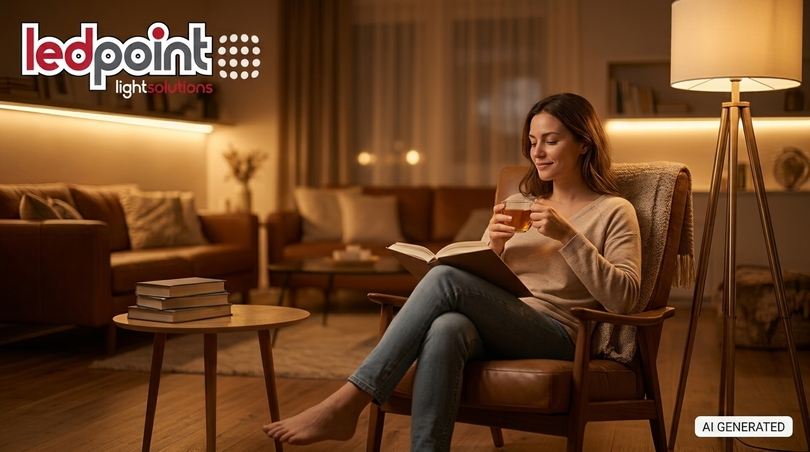
It is the best-known advantage. Warm light lowers the "visual tension" of an environment, makes spaces more intimate and invites you to slow down. This is why it is the light of domestic relaxation, of dinner, of hospitality. If you are wondering how to create warm and cosy lighting, the answer always starts here: temperature between 2700 and 3000 K, diffused and indirect light, adjustable intensity.
2. It respects evening rest
As we have seen, warm light stimulates the circadian system less. Which light is better for sleeping? A warm, low and indirect light in the hours before sleep, better still below 2700 K and dimmed. It is the principle behind our Circadian Light line, designed to accompany the natural rhythm of the day.
3. It enhances natural materials and skin tones
Wood, leather, terracotta, bricks, fabrics, brass and gold "come to life" under warm light. Human skin also appears healthier and more even: this is why hotels, spas, fashion boutiques and restaurants prefer it. A warm light with high CRI makes people more beautiful, literally.
4. It makes food more inviting
Bread, meat, desserts, pasta, red wine, aged cheeses: all foods with golden, red and brown tones appear more appetising under warm light. It is a decisive advantage in restaurants and food retail, as we will see in the dedicated section.
5. It reduces perceived glare
At the same luminance, warm sources are less annoying to look at than cold ones. In environments with indirect light, light coves and false ceilings, a warm-light LED strip reduces the sensation of glare on light surfaces.
6. It has an aesthetic and "brand" value
In commercial venues warm light communicates quality, craftsmanship, care. The customer unconsciously associates warm light with a premium experience; cold light with a functional, discount or technical context.
Summary of the advantages of warm light
| Advantage | For whom it is decisive | Recommended temperature |
|---|---|---|
| Cosy atmosphere | Families, hotels, restaurants | 2700-3000 K |
| Sleep and relaxation | Bedrooms, spas, holiday homes | 2200-2700 K |
| Enhancement of materials | Architects, interior designers, showrooms | 2700-3000 K, CRI>90 |
| Inviting food | Restaurateurs, bakeries, wine shops | 2700-3000 K, CRI>90 |
| Evening visual comfort | Everyone | 2700-3000 K dimmable |
| Premium perception | Retail, hospitality | 3000 K |
7. When warm light is not suitable
A good consultant does not sell the same solution to everyone. Warm light has many merits, but in some contexts it is the wrong choice, or at least it should not be the only one. In this section we analyse the cases in which neutral or cold light is preferable, explaining why with technical and regulatory criteria.
Work environments and concentration
Offices, professional studios, classrooms, laboratories: here the goal is alertness, not relaxation. The UNI EN 12464-1 standard on lighting of indoor workplaces does not impose a specific colour temperature, but requires high illuminance levels (for example 500 lux for writing and computer work) and a minimum colour rendering of Ra 80. At these levels, according to the Kruithof curve, a neutral 4000 K light is more natural and comfortable than a warm light. Warm light in the office tends to promote drowsiness in the afternoon hours.
Kitchen worktops
On the surface where you chop, peel and check cooking, you need crispness and colour fidelity. Warm or cold light in the kitchen? The professional answer is: both, but in different places. Warm 3000 K light for general lighting and the dining area, neutral 4000 K light under the wall units. A kitchen lit only with very warm light (2700 K) makes it difficult to assess the cooking of meat or the freshness of vegetables.
Bathroom mirror and make-up
To apply make-up, shave or care for your skin you need light that returns real colours. Light that is too warm "tans" the complexion and falsifies make-up tones; light that is too cold makes it look livid. The ideal solution at the mirror is a neutral 3500-4000 K light with CRI>90, possibly adjustable with a mirror dimmer.
Garages, workshops, cellars and technical rooms
Here it is important to see well, quickly and safely. Cold or neutral light (4000-6500 K) increases the perception of details and contrasts. Cool white LED strips and LED bars are the most practical choice for these environments.
Display windows for cold or technological products
Silver and platinum jewellery, steel watches, electronics, fresh fish, dairy products: all products that under warm light can appear yellowed. In these cases a neutral or cold light with very high colour rendering is preferable, such as the Sunled 4000K CRI Ra>97 LED strip, or strips with spectra dedicated to food.
Environments with a lot of daytime natural light
In an open space facing south, with large windows, very warm artificial light switched on during the day creates an unpleasant colour contrast: areas lit artificially appear "yellow" compared to those lit by the sun. During daytime hours neutral light is preferable, or a CCT (dynamic white) system that adapts.
Decision table: when NOT to choose warm light
| Situation | Why warm light is not suitable | Recommended alternative |
|---|---|---|
| Office, studio, school | Reduces alertness at high lux levels | 4000 K, CRI>80, 500 lx |
| Kitchen worktop | Falsifies the colours of raw food | 4000 K, CRI>90 |
| Make-up mirror | Alters the complexion | 3500-4000 K, CRI>90 |
| Garage and workshop | Lower perception of details | 4000-6500 K |
| Windows for silver, steel, fish | Yellows "cold" materials | 4000-5000 K, CRI>95 |
| Daytime environments with windows | Colour contrast with the sun | 4000 K or CCT |
| Environments with very high lux | Unnatural effect (Kruithof) | 3500-4000 K |
8. Where to use warm or cold light at home, room by room
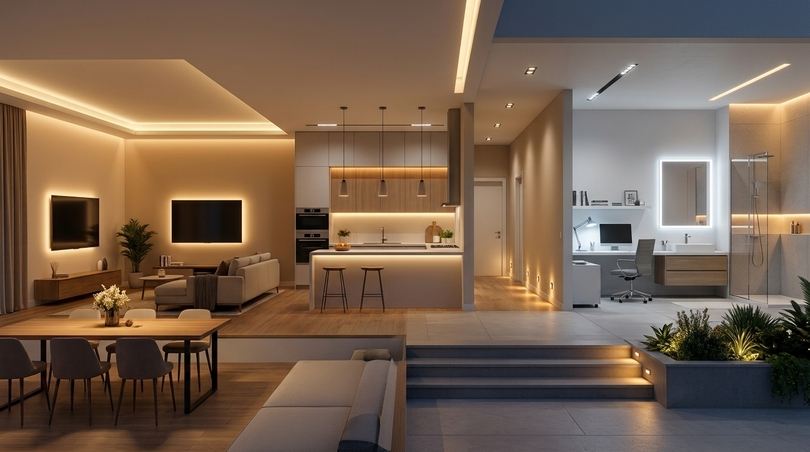
We come to the practical question that almost all homeowners and DIY enthusiasts ask themselves: where should warm light go and where cold light? In this section we go through the home room by room, indicating recommended temperature, illuminance levels, type of installation and suitable products. At the end you will find a summary table to save.
Living room and lounge
The living room is the kingdom of warm light. 2700-3000 K is the best choice for general and accent lighting. A perimeter light cove with COB 3000K CRI Ra>90 strip creates a soft and even indirect light; a strip behind the TV unit reduces the contrast between screen and wall; a few adjustable spotlights highlight paintings and bookcases. If the living room is also a study area, a CCT system or a neutral reading lamp is advisable.
Practical advice for the living room
Provide at least two separate and dimmable circuits: one for general light, one for accent light. A monochrome dimmer costs little and multiplies the possible atmospheres.
Bedroom
Which light is best for the bedroom? Warm light, 2700 K or even 2200-2500 K for night lights and atmosphere lighting. Avoid cold sources near the bed. A strip behind the headboard or under the bed, with a motion sensor, offers a courtesy night light that does not disturb sleep. For this use the COB 2200K strip or the COB 2500K are ideal, combined with Ledpoint motion sensors. In the walk-in wardrobe, on the other hand, a more neutral light is needed (3000-4000 K) to distinguish the colours of clothes well.
Kitchen: warm or cold light?
As anticipated, the kitchen is the environment where it is best to combine temperatures. Here are some kitchen lighting ideas that always work:
- General light: 3000 K, 150-300 lux, from ceiling lights or ceiling coves.
- Under-cabinet: 3000 K if the kitchen is also a living area, 4000 K if it is very operational; in both cases CRI>90 and a profile with diffuser to avoid reflections on glossy worktops.
- Island and table: 2700-3000 K for conviviality.
- Inside wall units and display cabinets: 3000 K to enhance crockery and glasses.
- Plinth: 2700 K at low intensity as a night light.
For the under-cabinet we recommend the 16 mm angled aluminium profile, which directs light at 45° towards the worktop and reduces glare.
Bathroom: warm or cold light?
For the bathroom the answer is "it depends on the area". Warm light 2700-3000 K for general and atmosphere lighting (especially in bathrooms with a bathtub, designed for relaxation); neutral light 3500-4000 K with CRI>90 at the mirror. Pay attention to the degree of protection: in areas near the shower and bathtub, products with an adequate IP protection rating are required (at least IP65 for strips in areas subject to splashes) and low-voltage 24 V power supply.
Corridors and stairs
Which light is better for a corridor, warm or cold? In residential corridors warm 3000 K light is the most harmonious choice, because the corridor connects environments usually lit with warm light. Strips under the steps or at skirting-board level, with a twilight or motion sensor, improve night safety without waking anyone. In condominium or service corridors, 4000 K can be used.
Study and home office
Here concentration is needed: neutral 4000 K light for the desk, possibly with a warm ambient light for the evening. A CCT system is perfect for those who work from home and then use the same room to relax.
Outdoors, terraces and gardens
In residential outdoors warm light is preferable for three reasons: it enhances plants and natural materials, disturbs nocturnal wildlife less and reduces the impact on light pollution, which is greater with blue components. Many Italian regional regulations on light pollution recommend contained temperatures. For outdoors, IP65 or IP67 strips and suitable profiles are required.
Summary table: warm or cold light at home
| Room | Recommended temperature | Indicative lux | Minimum CRI | Typical LED solution |
|---|---|---|---|---|
| Living room | 2700-3000 K | 150-300 | 90 | COB light cove + accent spotlights |
| Bedroom | 2200-2700 K | 100-200 | 90 | Strip behind headboard, night light with sensor |
| Walk-in wardrobe | 3000-4000 K | 200-300 | 90 | Strip in profile with opening sensor |
| Kitchen - general | 3000 K | 200-300 | 90 | Ceiling lights or ceiling cove |
| Kitchen - worktop | 3000-4000 K | 300-500 | 90 | Under-cabinet strip in angled profile |
| Dining room | 2700-3000 K | 150-300 | 90 | Dimmable pendant + indirect light |
| Bathroom - general | 2700-3000 K | 150-250 | 80 | IP65 strip in false ceiling |
| Bathroom - mirror | 3500-4000 K | 300-500 | 90 | Perimeter strip at the mirror |
| Corridor and stairs | 3000 K | 100-150 | 80 | Step marker or skirting board with sensor |
| Study / home office | 4000 K (or CCT) | 300-500 | 90 | CCT strip or neutral linear light |
| Garage and cellar | 4000-6500 K | 150-300 | 80 | LED bars or strips in profile |
| Outdoors | 2200-3000 K | 5-50 | 80 | IP67 strips and step markers |
Home lighting in winter
In the winter months the days get shorter and we spend more hours with artificial light. In winter warm light helps to create that feeling of "nest" that many call hygge, but it is useful to keep a more neutral and intense light in the early hours of the morning, to help waking up and counteract the drowsiness typical of the season. A dynamic white CCT system allows both needs to be managed with a single system.
9. Warm light in the restaurant: dining room, counter, kitchen and dishes
For those who run a restaurant, a trattoria, a bistro or a cocktail bar, light is not a décor detail: it is a sales tool. It influences how long customers stay, how much they order, how they perceive the dishes and how many photos they post on social media. In this section we answer the most frequent questions from restaurateurs: is warm or cold light better in a restaurant? Which light makes food more appetising? How to light the dining room, counter and kitchen with different temperatures?
Is it better to use warm or cold light in a restaurant?
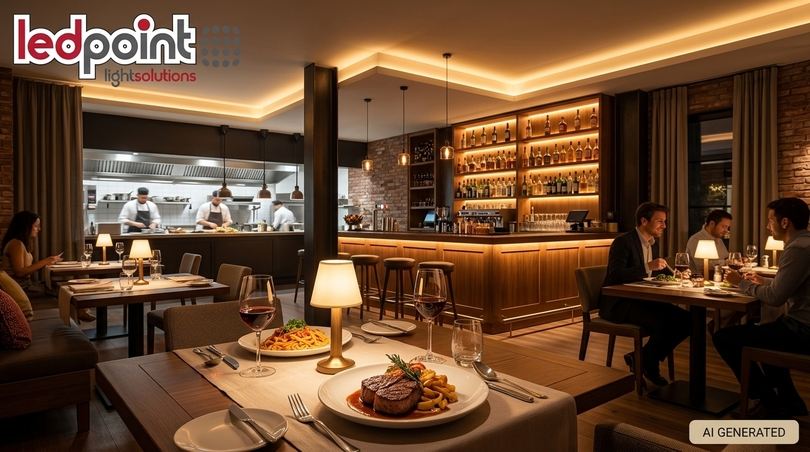
For a restaurant dining room warm light is almost always the correct choice, with a temperature between 2700 and 3000 K. It creates intimacy, makes guests feel at ease, enhances food and skin tones. Cold light in the dining room is justified only in very specific formats: fast food oriented towards rapid turnover, canteens, venues with a deliberately "technical" or minimal-industrial identity. Even in these cases, however, a 3500-4000 K is often chosen rather than a true cold white.
Which colour temperature is most suitable for a modern restaurant?
The modern restaurant, with clean lines and materials such as concrete, metal, glass and light wood, finds its balance around 3000 K: warm enough to be cosy, white enough not to look "vintage". The traditional restaurant, the trattoria with exposed beams, the osteria and the wine bar look their best with 2700 K or even with accents at 2200-2500 K that recall candlelight.
| Venue format | Dining room temperature | Light level | Objective |
|---|---|---|---|
| Fine dining / gourmet restaurant | 2700-3000 K | Low in the dining room, high on the dish | Experience, stay, focus on food |
| Modern restaurant / bistro | 3000 K | Medium | Contemporary welcome |
| Trattoria, osteria, farmhouse | 2700 K | Medium-low | Warmth, tradition |
| Wine bar, cocktail bar, lounge | 2200-2700 K | Low | Intimacy, evening socialising |
| Pizzeria and family restaurant | 3000 K | Medium-high | Conviviality, liveliness |
| Fast casual / daytime café | 3000-3500 K | High | Energy, turnover |
| Fast food / canteen | 3500-4000 K | High | Speed, perceived cleanliness |
Which light makes food more appetising on tables and in photos?
Food appears more inviting under a warm 2700-3000 K light with high colour rendering (CRI>90, preferably with high R9). The R9 index measures fidelity in rendering saturated red: it is the value that makes a tagliata look juicy, a tomato bright, a glass of red wine deep. An LED with CRI 80 and low R9, even if warm, makes meat look grey and sauces dull.
For dish photography, increasingly important for the visibility of the venue on Instagram, Google and TripAdvisor, two rules apply: avoid mixing different temperatures on the same table (which creates colour casts that the phone cannot correct) and ensure direct, soft light on the dish, without harsh shadows. A 3000 K spotlight with CRI>90 aimed at each table, combined with a warm, dimmed ambient light, is the configuration that offers the best results both for the eye and for the camera.
How to light dining room, counter and kitchen with different temperatures
Dining room
Warm general light at 2700-3000 K, preferably indirect (light coves, perimeter coves, backlighting of panels and boiserie). COB LED strips are ideal for this use because they produce a continuous line of light without dots even on glossy surfaces. Accent light on tables with dimmable spotlights or pendants.
Counter and bar
The counter is the stage of the venue. A warm-light strip under the top or inside a recessed profile creates a "blade" that invites you to come closer. Backlighting of bottle displays works very well at 2700-3000 K: the amber glass of whisky, cognac and amari lights up. For cocktail bars, coloured scenarios can be added with RGB+CCT strips, which combine saturated colours and adjustable white in a single strip.
Refrigerated displays and food counters
Here the temperature must be chosen according to the product: warm light for bread, desserts, cured meats, aged cheeses; neutral light for fish, fresh dairy products, vegetables. Ledpoint offers strips with specific spectra for food, designed to enhance the natural colours of the displayed products.
Professional kitchen
In the kitchen you need the light of a work environment: 4000 K, at least 500 lux on preparation surfaces and CRI>90 to assess cooking, freshness and plating. If the kitchen is open, the best solution is to separate the circuits: neutral light on the worktop, warm light on the pass and on the counter facing the dining room, so as not to "contaminate" the atmosphere of the tables.
Venue bathrooms
Often neglected, they are part of the experience. Warm general light 3000 K, neutral light with good CRI at the mirrors. A bathroom lit with cold, intense light breaks the atmosphere built in the dining room.
Does warm light really help create a cosier atmosphere in a venue?
Yes, and not only for reasons of taste. We have seen the studies that link warm, soft light to a longer stay and a better rating of the meal. To this is added a practical figure that we collect from projects carried out with our restaurant clients: when a venue moves from generic 4000 K lighting to a layered 2700-3000 K design with intensity control, the change most frequently reported is an increase in positive comments about the atmosphere in online reviews. Light is one of the elements that customers mention most often without realising it: "cosy place", "intimate atmosphere", "warm venue".
Lighting scenarios: lunch, dinner, after dinner
A restaurant changes audience and pace over the course of the day. With a controller and a few independent circuits you can create three scenarios:
| Scenario | Temperature | General light intensity | Notes |
|---|---|---|---|
| Lunch / fast service | 3000-3500 K | 70-100% | Consistent with daylight from windows |
| Dinner | 2700-3000 K | 40-60% | Accent on tables, perimeter indirect light |
| After dinner / bar | 2200-2700 K | 20-40% | Counter and bottle display highlighted |
| Cleaning and closing | 4000 K | 100% | Separate technical circuit |
With CCT LED strips and CCT controllers these scenarios can be managed by remote control, push button or app, including with protocols such as ZigBee or DALI.
10. Designing with warm light: the guide for architects
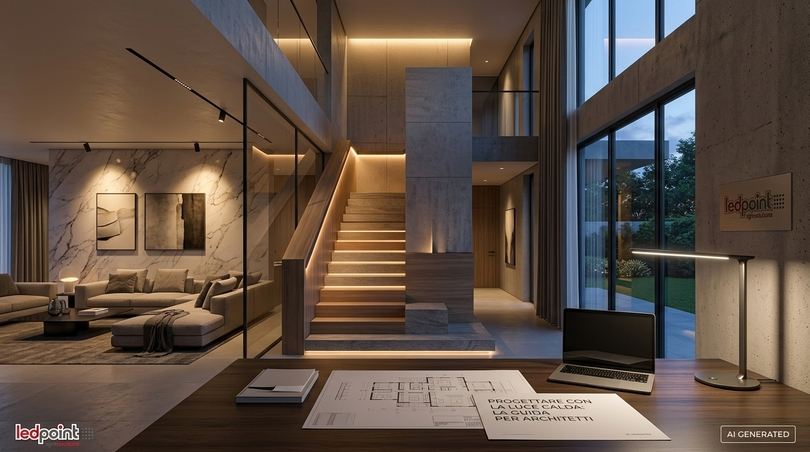
For architects, interior designers and lighting designers, colour temperature is only one of the variables in a project that must reconcile aesthetics, function, regulations and energy efficiency. In this section we address the design of systems that combine warm and cold light, the relationship with natural light, the choice of colour rendering and the balance between light quality and consumption.
The principle of layered lighting
Every successful interior lighting project is based on three levels, which work together:
- General light (ambient): guarantees basic illuminance and orientation. Usually indirect or diffused.
- Functional light (task): dedicated to activities (worktop, reading, mirror). More intense and often more neutral.
- Accent light (accent): highlights objects, materials, works, architecture. Creates visual hierarchy and depth.
Warm light is naturally the light of ambient and accent; neutral light is often the light of task. Combining warm and neutral light coherently is the secret of a balanced and versatile environment.
How to combine warm and cold light without mistakes
Mixing warm and cold light "without criteria" is one of the most common mistakes. But combining them with a design is a refined technique. The rules we follow:
- One dominant temperature per environment: general light must be consistent throughout the space visible at the same time.
- Differences of at least 1000 K if intentional: a 3000/4000 K contrast is readable as a design choice; a 2700/3000 K contrast between two nearby fixtures looks like a mistake.
- Physical or functional separation: neutral light remains confined to the work area (under-cabinet, desk, mirror).
- Same colour rendering: sources with different CRI placed side by side create unevenness even at the same Kelvin.
- Strict colour tolerance: choose sources with binning within 3 MacAdam steps, so that multiple strips of the same temperature appear identical.
Colour tolerance: why "3step" matters
Two strips both declared "3000K" can appear slightly different: one more pinkish, the other more greenish. The measure of this difference is expressed in steps of the MacAdam ellipses (SDCM). Within 3 steps the difference is practically imperceptible to the human eye; beyond 5 steps it becomes visible in continuous installations. Many Ledpoint strips, such as the 3000K 3step 120 LED/m 24V 14.4W/m strip, are selected within 3 steps: an essential requirement for long light coves, coves and continuous profiles in prestigious projects.
What is the ideal colour rendering for domestic environments?
The colour rendering index (CRI or Ra) measures how faithfully a source reproduces colours compared to a reference source. Here are the thresholds we recommend:
| CRI (Ra) | Quality | Recommended use |
|---|---|---|
| Ra 80-85 | Good | Corridors, technical rooms, garages, decorative lighting |
| Ra 90-93 | Excellent | Residential, restaurants, hotels, prestigious offices |
| Ra 95-97+ | Outstanding, "sun-like" | Galleries, museums, showrooms, food retail, fashion, colour booths |
For domestic environments Ra>90 is now the recommended standard, especially in the kitchen, bathroom and living room. The "CRI 80 vs CRI 90" debate is easily resolved: the cost difference is small, the difference in perceived quality is evident, especially with warm light, where a low CRI tends to make reds look dull. For top-level projects the Sunled line offers a colour rendering of Ra>97, with a spectrum very close to that of sunlight.
How does natural light influence the choice between warm and cold light?
The natural light entering through windows varies by orientation, season and time. Some design indications:
- North-facing environments: receive diffused and "cold" light (6500-7500 K). Warm artificial light compensates for the effect and makes the environment cosier, especially in winter.
- South- and west-facing environments: direct, warmer light in the afternoon; warm 2700-3000 K artificial light in the evening naturally continues the sunset.
- Daytime work environments with windows: neutral 4000 K artificial light to blend with solar light.
- Multifunctional environments: tunable white (CCT) systems that follow the natural variation of the day.
Human Centric Lighting and circadian light
The Human Centric Lighting (HCL) approach designs light according to biological well-being and not only vision. In practice it means varying temperature and intensity over the course of the day: more neutral and intense in the morning, warm and dimmed in the evening. CCT strips 2700-6500 K or the Circadian Light line, combined with programmable controllers, make it possible to create HCL systems even in residential settings at affordable costs.
How to combine energy efficiency and light quality
An efficient project is not the one with the fewest watts installed, but the one that provides the right light, where it is needed, when it is needed. The main levers:
- Choose high-efficiency sources (over 130 lm/W for general light), such as high-efficiency Ledpoint strips with energy class declared according to the ErP regulation.
- Use indirect light wisely: bouncing on light surfaces is efficient; on dark surfaces it disperses a lot of light.
- Dim: an LED at 60% consumes about 60% and is often enough for warm evening light.
- Presence and daylight sensors in corridors, bathrooms, cellars and walk-in wardrobes.
- Quality power supplies, sized with a 20% margin over the load: a 24V power supply working at 80% lasts longer and is more efficient.
By combining these measures, warm light is by no means incompatible with energy efficiency: the small loss of lm/W compared to cold light is more than offset by a well-sized and adjustable design.
11. How to choose a warm-light LED strip
We have established where and when to use warm light. Now let's see how to turn theory into a concrete purchasing decision. An LED strip is not chosen only by Kelvin: lumens per metre, colour rendering, voltage, LED density, technology (SMD or COB), degree of protection and accessories make the difference between a professional result and a disappointing one. In this section you will find a complete checklist and a comparison table of the main Ledpoint warm-light products.
The selection criteria, one by one
1. Colour temperature
Choose according to the environment and the desired atmosphere: 2200-2500 K for candle effects and night lights, 2700 K for relaxation and intimacy, 3000 K for versatility. If in doubt, 3000 K is the choice that is least likely to go wrong.
2. Lumens per metre
Determines the quantity of light. Indicatively: 300-600 lm/m for decorative and accent light, 800-1200 lm/m for light coves and main indirect light, 1400-2500 lm/m for direct functional light or high false ceilings.
3. Colour rendering
Ra>80 for technical or decorative uses, Ra>90 for residential and restaurant, Ra>95 for displays and food retail.
4. Voltage: 12V, 24V or 230V
24V LED strips are the standard for most installations: they allow longer runs without brightness drop compared to 12V LED strips, which remain useful for short runs and furniture. For very long lines there are 48V strips and those with constant current control, which keep brightness and hue uniform from start to finish. 230V strips are practical for outdoors and temporary installations, but require attention to flicker and safety regulations.
5. Technology: SMD or COB
SMD strips (for example with 2835 chips) have distinct LEDs and offer maximum efficiency; COB strips have very closely spaced chips covered by a continuous phosphor layer and produce a perfectly uniform line of light, without dotting, even without a diffuser. For warm atmosphere light on reflective surfaces, COB is often the most elegant choice.
6. Colour tolerance (MacAdam steps)
For continuous installations choose strips selected within 3 steps, as explained in the section dedicated to architects.
7. Profile and diffuser
An aluminium profile dissipates heat, extends the life of the strip and, with an opal diffuser, makes the light softer. The 17x8 mm profile is the most versatile; for plasterboard there is the recessed plasterboard profile 44x12 mm, perfect for flush light cuts.
8. Power supply and control
Calculate the total power (W/m × metres) and add a 20% margin. If you want to adjust the intensity of warm light, provide a dimmer; if you want to vary the temperature, a CCT strip with the relevant controller.
Comparison table: Ledpoint warm-light LED strips
The following data come from the Ledpoint technical datasheets and allow a direct comparison of the most requested solutions for warm light.
| Product | Kelvin | Technology | Lumen/m | Efficiency | Power | CRI | Ideal for |
|---|---|---|---|---|---|---|---|
| COB 2200K 320 LED/m 24V | 2200-2400 K | COB | 610 | 70 lm/W | 9.6 W/m | Ra>90 | Candle effect, wine bars, night lights |
| COB 2500K 320 LED/m 24V | 2500-2700 K | COB | 830 | 95 lm/W | 9.6 W/m | Ra>90 | Bedrooms, lounges, hotels |
| COB 2700K 400 LED/m PCB 5mm | 2700 K | COB | 1030 | 100 lm/W | 11 W/m | Ra>90 | Slim profiles, furniture, living rooms |
| COB 3000K 320 LED/m 24V | 3000 K | COB | 785 | 95 lm/W | 9 W/m | Ra>90 | Light coves, coves, restaurants |
| COB 3000K 400 LED/m PCB 5mm | 3000 K | COB | 880 | 85 lm/W | 11 W/m | Ra>93 | Furniture, display windows, bottle displays |
| COB 3000K 50 m | 3000 K | COB | 785 | 95 lm/W | 9 W/m | Ra>90 | Large projects, installers |
| SMD 2835 3000K 3step 120 LED/m | 3000 K | SMD | 1410 | 110 lm/W | 14.4 W/m | Ra>80 | General indirect light, false ceilings |
| SMD 2835 3000K 3step 240 LED/m | 3000 K | High-efficiency SMD | 2000 | 155 lm/W | 14.4 W/m | Ra>80 | Main light, maximum efficiency |
An interesting reading of this data: for the main light of an environment the SMD 3000K at 155 lm/W offers the best light/consumption ratio, while for atmosphere and accent light COB strips guarantee superior visual quality thanks to the absence of light dots and higher colour rendering.
How to choose an LED bulb based on Kelvin
For those who need to replace old bulbs with warm-light LED bulbs, the same principles apply: read the Kelvin (2700 K to replace incandescent, 3000 K to replace halogen), check the lumens (not the watts), look for a CRI of at least 80, better 90, and check compatibility with the dimmer if present. Ledpoint also offers a selection of LED bulbs and spotlights.
| Old bulb | Equivalent lumens | Recommended LED | Temperature to maintain the same effect |
|---|---|---|---|
| 40 W incandescent | about 470 lm | 5-6 W LED | 2700 K |
| 60 W incandescent | about 800 lm | 8-9 W LED | 2700 K |
| 100 W incandescent | about 1500 lm | 13-15 W LED | 2700 K |
| 35 W halogen (GU10) | about 300-350 lm | 4-5 W LED | 3000 K |
| 50 W halogen (GU10) | about 450-500 lm | 6-7 W LED | 3000 K |
12. Warm light and consumption: the real data
"Do warm-light bulbs consume as much as cold-light ones?" It is a legitimate question, especially in a period of attention to energy costs. In this section we answer with concrete numbers, calculating the annual cost of a warm-light LED strip system and comparing it with alternative solutions.
The short answer
At the same wattage, a warm-light source consumes exactly as much as a cold-light one. Consumption depends on power, not colour. The difference is in efficiency: to obtain the same lumens, a warm light may require 5 to 20% more power, depending on the product and colour rendering. With modern high-efficiency LEDs this difference has become marginal.
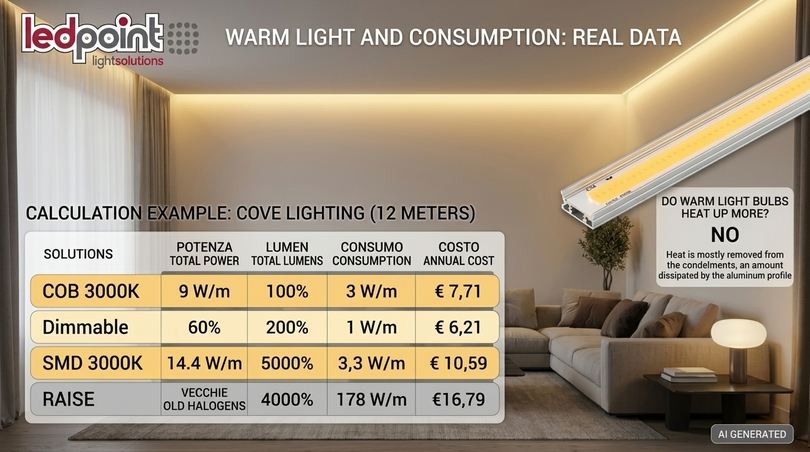
Calculation example: living room light cove
Let's assume a 12-metre perimeter light cove in a living room, switched on 4 hours a day for 365 days, with an energy cost of €0.25/kWh.
| Solution | Total power | Total lumens | Annual consumption | Annual cost |
|---|---|---|---|---|
| COB 3000K 9 W/m (100% intensity) | 108 W | about 9420 lm | 158 kWh | about €39 |
| COB 3000K 9 W/m (dimmed to 60%) | about 65 W | about 5650 lm | 95 kWh | about €24 |
| SMD 3000K 155 lm/W, 14.4 W/m at 50% | about 86 W | about 12000 lm | 126 kWh | about €31 |
| Old equivalent halogens (about 10 lm/W) | about 940 W | about 9400 lm | 1372 kWh | about €343 |
Indicative calculation: actual power also depends on the efficiency of the power supply and the dimmer curve.
The comparison shows that the real saving does not lie in choosing between warm and cold light, but in switching to efficient LEDs and in dimming. A warm light dimmed in the evening consumes less than a cold light switched on at full power.
Do warm-light bulbs heat up more?
No. The term "warm" is purely chromatic. Among the most frequent searches is precisely that of "bulbs that do not heat up": all LEDs produce much less heat than incandescent and halogen lamps, regardless of colour. The heat of an LED strip is concentrated on the back of the circuit and is managed by the aluminium profile.
13. Warm light in photography and video
Colour temperature is a concept born precisely in photography and cinematography, before interior lighting. Understanding how warm light interacts with cameras and smartphones is useful for restaurateurs photographing dishes, architects documenting projects and content creators for social media.
White balance with warm and cold light
Cameras try to make what is white appear "white" through white balance. With warm light, if the balance is set to "daylight" (about 5500 K), the image will appear orange; if set to "tungsten" (about 3200 K), the colours will be neutral. Smartphones make this correction automatically, but often only in part, to preserve the atmosphere. The typical result of a photo in a venue with warm light is a warm but pleasant image; the problem arises with mixed lights, where part of the scene is warm and the other cold and no correction works.
Practical rules for photographing with warm light
- Use a single colour temperature in the scene.
- Prefer sources with CRI>90: photos will have richer colours and more natural skin.
- Avoid cheap LEDs with flicker: in videos they appear as scrolling dark bands.
- For videos in restaurants, keep an accent light on the subject at 3000 K and a lower ambient light at 2700 K: guaranteed depth.
Colour temperature in video and social content
In social content, warm light communicates authenticity, craftsmanship and "real life". Many cooking creators use 3000-3200 K panels precisely for this reason. Dimmable warm-light strips are an economical alternative for creating warm backgrounds and contour lights in small photographic sets.
14. The most common mistakes (and how to avoid them)
In years of technical assistance to individuals, installers and design studios, we have seen the same mistakes recur. Knowing them before buying saves time, money and frustration. Here are the most frequent, with the solution for each.
1. Using a single hue everywhere
Putting 4000 K throughout the house "because it gives more light" or 2700 K even in the kitchen and at the mirror. Solution: choose the temperature according to the function of each area, following the room-by-room table.
2. Mixing warm and cold light without criteria
A 6000 K ceiling light next to 2700 K spotlights creates a messy effect. Solution: one dominant temperature per environment and differences only intentional and functional.
3. Confusing lumens and Kelvin
Choosing a cold light to get more light. Solution: increase the lumens, not the Kelvin.
4. Light that is too cold in relaxation environments
It is the most widespread mistake in Italian homes. How to avoid light that is too cold? Replace sources above 4000 K in the living room and bedroom with warm 2700-3000 K light, and prefer indirect light.
5. Light that is too warm where precision is needed
The opposite case: 2200 K light on the kitchen worktop or at the mirror. How to avoid light that is too warm? Reserve temperatures below 2700 K for atmosphere and night lights.
6. Ignoring colour rendering
A warm light with low CRI makes everything look dull and opaque. Solution: Ra>90 in inhabited environments.
7. Installing strips without a profile
A strip stuck directly onto wood or plasterboard overheats, loses brightness, changes hue over time and shows the light dots. Solution: aluminium profile with diffuser.
8. Undersizing the power supply
A power supply at 100% of the load heats up and fails sooner. Solution: 20% margin.
9. Buying strips from different batches
Two rolls purchased at different times may have a slight difference in hue. Solution: buy all the material together and prefer strips with 3-step tolerance.
10. Forgetting intensity control
Warm light is at its best when it is adjustable. Solution: always provide a dimmer for atmosphere lights.
15. How to turn cold light into warm light
Have you already installed cold lights and realise that the environment is not cosy? You don't always need to redo everything. In this section we look at the possible solutions, from the simplest to the most complete.
Replace the source
The most effective solution: replace the strip or bulb with an equivalent warm-light one. LED strips are easy to cut and connect with PCB connectors; if the profile and power supply are adequate, the change takes a few minutes.
Switch to a CCT strip
If you don't know which temperature you prefer or want both, the definitive solution is dynamic white: CCT strips contain warm and cold LEDs and, with a controller, allow you to switch from warm to cold light and all intermediate hues. It is the ideal choice for kitchen-living rooms, home offices, restaurants with lunch and dinner service.
Use diffusers or filters
Coloured filters (amber gels) used in theatre and photography can "warm up" a cold light, but they greatly reduce lumens and worsen colour rendering. They are a temporary solution, not a professional intervention.
Work on materials
Walls in warm tones, wood, fabrics and opaque surfaces reflect warmer light. They do not turn cold light into warm light, but they attenuate its effect.
Dim to warm: the light that warms up as you dim it
"Dim to warm" sources imitate the behaviour of incandescence: lowering the intensity lowers the temperature, for example from 3000 K to 1800-2200 K. The same effect can be achieved with a CCT strip and a controller programmed to combine intensity and temperature. It is the most appreciated effect in restaurants and hotel rooms.
16. Frequently asked questions about warm light
We have collected the questions we most often receive from private customers, installers, restaurateurs and designers. Click on each question to read the answer.
What is warm light?Warm light is a white light with a yellow-amber hue, with a colour temperature between 2200 and 3300 K. It recalls incandescence or candlelight, contains little blue light and creates cosy and relaxing atmospheres. It is suitable for living rooms, bedrooms, dining rooms, restaurants and hotels, especially in the evening hours. |
What is the difference between warm and cold light?Warm light has few Kelvin (2200-3300 K) and a yellow hue that relaxes; cold light has many Kelvin (above 5300 K) and a blue-white hue that stimulates attention and concentration. The quantity of light depends on lumens, not colour: at the same lumens they illuminate the same way. |
Is 3000K light warm or cold?3000K light is warm. It is a cleaner warm white than 2700K, similar to that of halogen lamps. It is the most versatile temperature for home and restaurant: cosy but crisp enough to read, cook and see the colours of food and materials clearly. |
Is 4000K light warm or cold?Neither: 4000K light is neutral, also called natural white. It appears white and bright, similar to morning light. It is ideal for working kitchens, bathroom mirrors, offices and studies. In evening relaxation environments it can feel impersonal compared to warm light. |
What is the difference between 2700K and 3000K?Both are warm light. 2700K is more yellow and intimate, similar to incandescence; 3000K is whiter and more versatile, similar to halogen. 2700K is perfect for bedrooms and romantic environments, 3000K for living rooms, modern restaurants and environments where a little crispness is also needed. |
Warm or cold light in the kitchen?The best solution is to combine them: warm 3000K light for general lighting and the dining area, neutral 4000K light with CRI above 90 under the wall units, on the worktop. This way the kitchen remains cosy and at the same time functional for preparing and checking food. |
Warm or cold light in the bathroom?In the bathroom a warm 2700-3000K light is advisable for general and atmosphere lighting, and a neutral 3500-4000K light with high colour rendering at the mirror, for applying make-up and shaving while seeing real colours. In damp areas use products with an adequate protection rating, for example IP65. |
Which light is best for sleeping?To promote sleep, a warm, low and indirect light is better in the evening hours, ideally between 2200 and 2700K and dimmed. Warm light contains less blue and interferes less with melatonin production. Avoid cold and intense lights in the bedroom before sleeping. |
Do warm-light bulbs consume more?No: at the same wattage they consume the same. To obtain the same lumens, a warm light may require 5 to 20% more power, depending on the product and colour rendering. With high-efficiency strips, such as the Ledpoint 3000K at 155 lm/W, the difference becomes negligible. |
How can I tell whether a bulb is warm or cold light?Read the Kelvin value on the packaging: below 3300K it is warm light, between 3300 and 5300K neutral, above it is cold. Alternatively look at the three-digit code (827 or 830 indicate warm light) or illuminate a white sheet: if it appears cream the light is warm, if it appears bluish it is cold. |
Which light makes food more appetising in a restaurant?A warm light between 2700 and 3000K with a colour rendering above 90 and a good R9 value on reds. It makes meat, bread, sauces and wine appear more inviting. For dish photos, avoid mixing different temperatures on the table and aim a direct, soft light at the dish. |
Is cold light bad for the eyes?Cold light does not damage the eyes under normal conditions, but it can be more tiring in the evening and in relaxation environments, due to the greater contrast and perceived glare. Visual comfort depends above all on diffusion, absence of flicker and good colour rendering, as well as on colour temperature. |
What does warm white mean?Warm white is the English term for bianco caldo, i.e. warm light. It indicates sources between about 2700 and 3200K. If the label is "extra warm white" the temperature is lower, between 2200 and 2500K, with a candle-like effect. Cool white and cool daylight indicate cold light instead. |
How do you turn cold light into warm light?The most effective method is to replace the source with an equivalent warm-light one. If you want to be able to choose, install a CCT LED strip with controller, which allows you to adjust the temperature from warm to cold. Coloured filters are only a temporary solution because they reduce brightness and colour rendering. |
Which colour temperature should be used in a corridor?In residential corridors a warm 3000K light is preferable, consistent with the rooms they connect, preferably with motion sensors and low-intensity step markers for the night. In service corridors, offices or condominiums a neutral 4000K light can be used, more functional and active. |
How many lumens are needed with warm light?You need the lumens required by the environment: about 150-300 lux in the living room, 100-200 in the bedroom, 300-500 on the worktop. With warm light it is advisable to add 10-15% more lumens because it is perceived as slightly less bright. For a light cove, 800-1200 lumens per metre are generally enough. |
17. The right choice in three steps
We started from a simple question, "what is warm light?", and arrived at designing restaurants, homes and professional systems. To close, let's summarise everything in a practical method that you can apply to any environment.
Step 1: define the function
Relaxation, conviviality, hospitality? Warm light 2700-3000 K. Work, precision, colour control? Neutral light 4000 K. Technical environment? Neutral or cold light. Multifunctional environment? Dynamic white CCT.
Step 2: choose quality
Colour rendering Ra>90 in inhabited environments, colour tolerance within 3 steps, lumens suited to the function, aluminium profile with diffuser and power supply with margin.
Step 3: provide control
Dimmer for atmosphere light, separate circuits for the different layers of light, sensors in passageways. An adjustable warm light is worth more than any expensive lamp always switched on at full power.
Warm light is not a fashion nor an aesthetic detail: it is a tool that affects well-being, sleep, appetite, the perception of spaces and even the results of a commercial activity. Used in the right place it makes a home cosy and a restaurant memorable; used in the wrong place it makes work tiring and falsifies colours. Now you have all the tools to choose with awareness.
If you are designing a system, discover all the Ledpoint warm-light LED strips, read more about ceiling installation in our guide to LED strips for ceilings, consult the other articles on the Ledpoint blog or contact our technical office for a quote and advice on your project. You can also download updated datasheets and catalogues.
This article was developed with the support of artificial intelligence and subsequently reviewed, corrected and validated by the Ledpoint.it technical team, which guarantees its reliability and compliance with official sources.